
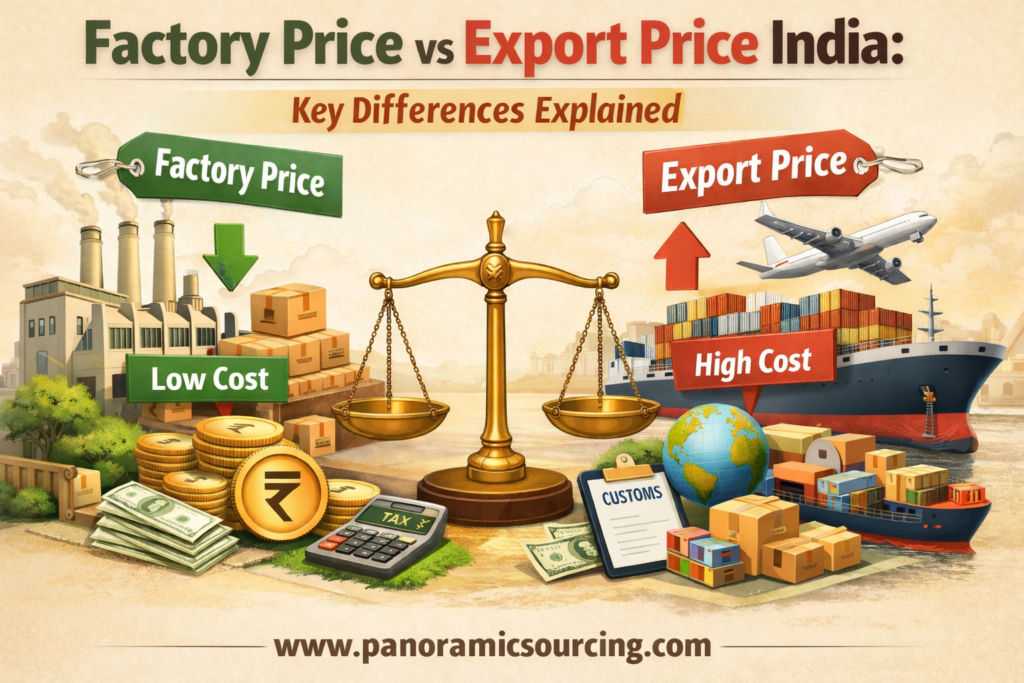
Factory Price vs Export Price India: Key Differences Explained
If you’ve ever looked at a quote from an Indian manufacturer and felt like the numbers were doing gymnastics, you aren’t alone. One minute you’re looking at a fantastic price on the factory floor and the next, the “final” quote for your shipment has jumped up by 15% or 20%. It’s easy to feel like you’re being hit with hidden fees, but usually, it just comes down to the fundamental difference between Factory Price vs Export Price India.
In simple terms, it is the difference between what it costs to make something and what it costs to actually move it out of the country. For any business owner, understanding this gap is the secret to protecting your profit margins. If you don’t know where that extra money is going, you can’t negotiate effectively and you definitely can’t price your products accurately for your customers. Let’s pull back the curtain and break this down in plain, human language.
The Factory Price: The “As-Is” Cost of Making
Think of the factory price (which pros call Ex-Works or EXW, defined under the Incoterms International Trade Rules as the “naked” cost of your product. This is the price of the goods as they sit on the shelf in the warehouse in a place like Jaipur, Kanpur, or Jodhpur. If you could walk into the workshop, hand over a stack of cash and carry the boxes out to your own car, this is the price you would pay.
What exactly are you paying for here?
When we talk about Factory Price vs Export Price India, the factory side is strictly focused on the “creation” of the item:
Raw Materials: The literal cost of the leather hides, the solid wood, the hand-woven fabric, or the brass hardware.
Artisanal Labor: The wages paid to the people who actually do the work—the stitchers, the carvers and the quality checkers.
Factory Overhead: The cost of keeping the lights on, renting the facility and maintaining the machinery.
The Maker’s Margin: The small profit the factory keeps to stay in business and grow.
The catch with a factory price is that once the goods are packed in a box, the factory’s job is officially done. They aren’t responsible for getting those boxes to the port, they aren’t responsible if a truck breaks down on the highway and they aren’t responsible for talking to customs officials. In this scenario, the “local headache” is 100% yours.
The Export Price: Getting the Goods “Port-Ready”
The export price (usually quoted as Free on Board or FOB) is the cost of the goods once they have cleared Indian customs and are physically sitting on the ship or plane. For the vast majority of international buyers, this is the “real” price they use to build their business models.
The Layers That Build the Export Price
The jump from Factory Price vs Export Price India isn’t just a random markup; it’s a collection of essential services required to move goods through a large and complex country. Here is where that extra money actually goes:
Inland Trucking (The Long Haul): India is a massive country. Many of the best manufacturing hubs are located hundreds of miles away from the coast. Moving a container from an inland city to a massive port like Mundra or Nhava Sheva can take three to five days and involves heavy fuel costs, state border tolls and driver fees.
Export-Grade Packaging: Domestic boxes are fine for a short truck ride, but they won’t survive a month in a humid, salt-aired shipping container. The export price includes heavy-duty, double-walled cartons, moisture-absorbing silica gel and professional palletizing.
The Paperwork (CHA Fees): You can’t just drive a truck onto a ship. You have to hire a Customs House Agent (CHA) to file legal documents with the Indian government. They handle the “Shipping Bill” and ensure you get a “Let Export Order” so your goods aren’t seized.
Port and Loading Fees: Docks are busy places that charge for everything. There are Terminal Handling Charges (THC), gate-in fees and labor costs for physically moving your pallets from the truck into the container and onto the vessel.
How Panoramic Sourcing Simplifies the Math
At Panoramic Sourcing, we’ve seen too many buyers get “price shock” because they didn’t understand the difference in Factory Price vs Export Price India. We believe that honesty in pricing is the only way to build a long-term partnership. We don’t want you to get a great deal on a product only to be hit with a massive “handling fee” right before the ship sails.
How we audit the numbers for you:
We don’t just take a factory’s word for it. We look at the factory price vs export price India breakdown with a magnifying glass:
We Negotiate Inland Freight: Because we move a lot of volume, we can often get better trucking rates than a single factory could find on their own.
We Check the Packing: We make sure the “export price” actually includes the high-quality packing needed for your specific product.
We Handle the Red Tape: We ensure all the necessary certificates—like Fumigation or Certificates of Origin—are included in the price upfront, so there are no “surprise” bills at the destination.
Our goal is to give you a “Landed Cost” estimate that actually holds up. We want you to know your margins before you even place the order. By comparing factory price vs export price India, we find the most efficient route for your budget.
Conclusion
At the end of the day, the Factory Price vs Export Price India debate is really about transparency. The factory price shows you the value of the artisan’s skill, while the export price shows you the reality of the global market.
By knowing exactly what goes into these numbers, you can source with total confidence. You’ll know when a quote is fair and you’ll know when someone is trying to pad their margins with “shipping fees.” Whether you want to handle the logistics yourself or want us to take care of the heavy lifting, understanding factory price vs export price India is the first step toward a successful business.
FAQs
1. Is the export price just a hidden markup?
Not at all. It reflects the real-world costs of trucking and the legal fees required to clear customs.
2. Does FOB include the shipping to my home country?
No. The Factory Price vs Export Price India comparison ends once the goods are on the ship. The “Ocean Freight” is a separate charge.
3. Why is the price gap bigger for small orders?
Customs paperwork has “fixed costs.” On a small order, those fees are spread over fewer items, making the factory price vs export price India gap feel much wider.
4. Which price is more common for US or UK buyers?
Most prefer FOB (Export Price) because it makes accounting simpler and puts the responsibility for local delays on the manufacturer.
5. Can the export price change after I pay a deposit?
It shouldn’t. A good partner will lock in the price when you sign the deal, keeping the factory price vs export price India ratio stable.