
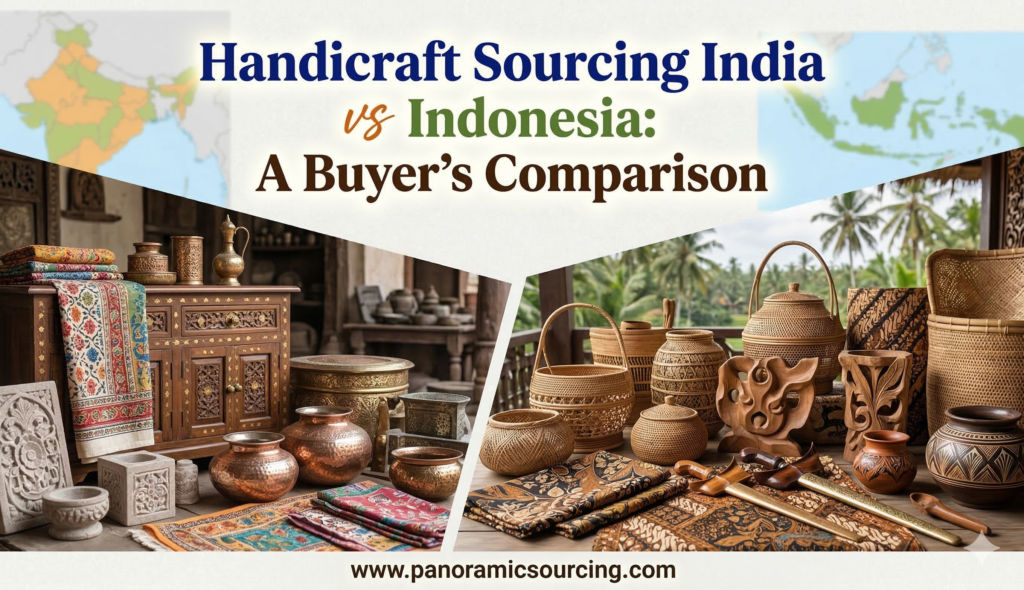
Handicraft Sourcing India vs Indonesia: A Buyer’s Comparison
Let’s be real: “Handmade” is the biggest buzzword in retail right now. But if you’re a buyer, the excitement dies the second you have to choose between two massive hubs. The Handicraft Sourcing India vs Indonesia debate isn’t just about who is cheaper. It’s about which country’s artistic soul actually fits your brand. You’ve got one that’s the absolute king of metals and textiles and another that owns the market for raw, organic wood.
As we hit March 2026, the game has shifted. India has pumped a ton of money into infrastructure via the Gati Shakti master plan, making it a logistics beast. Meanwhile, Indonesia has doubled down on that “slow living”, high-end tropical look that boutique hotels crave. If you’re trying to fill a container, you need to know where the actual value is hiding.
1. The Material Game: Metal vs. Fiber
The first rule of Handicraft Sourcing India vs Indonesia? Don’t fight the geography. You don’t go to Indonesia for brass and you don’t go to India for rattan.
India’s Hub-Based Power
India is a beast. It’s a network of 7 million artisans, but it’s organized into “hubs”. They’ve been doing one thing for centuries.
The Brass City (Moradabad): If you need sand-casted aluminum, hammered copper, or brass, you go here. No one else touches their price or detail at scale.
Textile Dominance: From Jaipur’s block prints to the heavy embroidery of the North, India owns the “soft goods” space.
Patient Craft: Whether it’s bone, horn or marble, Indian craftsmen have a level of patience for detail that’s hard to find anywhere else.
Indonesia’s Organic Soul
Indonesia is the heart of the “tropical modern” look. If your brand is all about texture and natural tones, this is your spot.
The Rattan King: They supply about 70% of the world’s rattan. Their weaving with seagrass and water hyacinth is on another level.
Wood Heritage: In places like Jepara, woodcarving is a way of life. The teak and suar wood furniture from Bali and Java has a weight and “soul” that feels truly premium.
2. The Math: Pricing and MOQs
When you’re looking at Handicraft Sourcing India vs Indonesia, the “landed cost” is what keeps you up at night.
India Wins on Volume
For mid-to-high volume, India usually takes the trophy. They have a mature “Export House” system where big factories pull from small clusters. This means:
Efficiency: Labor is competitive and finishing is industrialized. This keeps per-unit costs low even when global raw material prices spike.
Better MOQs: Indian suppliers are generally much more willing to move on Minimum Order Quantities than most Indonesian shops.
The Indonesian Premium
Indonesia is rarely the “budget” play. It’s a premium move.
Small-Batch Reality: A lot of production happens in family workshops. It’s authentic, but scaling to 5,000 identical units can be a massive headache.
Logistics Math: Being an archipelago is tough. Moving goods from Bali to a port like Jakarta adds cost and risk that you just don’t see in India’s land-based networks.
3. Shipping: Getting Goods Out the Door
You can’t talk about Handicraft Sourcing India vs Indonesia without the logistics headache.
India has made huge strides. Their recent MSME export promotion initiatives have cut the red tape for MSME exporters and ports like Mundra are now seeing record-low dwell times. Indonesia is professional, too, but you have to watch the weather. During monsoon season, your wood and rattan drying times will explode, potentially turning a 60-day lead time into a 4-month wait.
The 2026 Certification Trap: Recycled vs. Certified
It isn’t enough to just find a pretty product anymore. In 2026, the global market—especially the EU with its Digital Product Passport and the US with stricter import audits—is hammering down on traceability. When you look at Handicraft Sourcing India vs Indonesia, the compliance path depends entirely on the material. If you’re sourcing from India, you’ve got a massive advantage in the recycled metal space. Most Moradabad factories are now using certified recycled aluminum and copper, which is a huge selling point for eco-conscious brands.
In Indonesia, the focus is different; you have to be obsessive about the updated SVLK (Timber Legality and Sustainability) tracking. If your Indonesian supplier can’t show you the digital paper trail for that suar wood table, your shipment could get flagged before it even leaves the port. Choosing between handicraft sourcing India vs Indonesia in 2026 means choosing the country that can prove its provenance on paper.
Seasonality: The Silent Lead-Time Killer
One thing new buyers always forget is the weather. When managing Handicraft Sourcing India vs Indonesia, the climate is your biggest unwritten risk factor. In India, the record heatwaves we’ve seen in May 2026 can actually slow down metal polishing; the workshops simply get too hot for workers to maintain the precision needed for a high-end finish. In Indonesia, the humidity is your biggest enemy.
We’ve seen 60-day lead times turn into 4-month nightmares because a supplier didn’t have the proper industrial drying kilns. Knowing which factories have the right tech to fight the climate is the only way to protect your margins when navigating handicraft sourcing India vs Indonesia.
Why Choose Panoramic Sourcing?
Navigating the Handicraft Sourcing India vs Indonesia divide is a full-time job. You can’t do it from a desk halfway across the world. You need people on the ground who know which factory is legit and which one is just a middleman with a fancy catalog.
At Panoramic Sourcing, we live in these hubs. We find that sweet spot where “artisanal charm” meets “export-quality standards”. Whether you’re chasing the brass lusters of Moradabad or the intricate woodcraft of Saharanpur, we make sure the final product actually looks like your sample.
What We Actually Do:
On-Ground Audits: We don’t trust photos. We visit the units, check the floors and verify the capacity.
Zero-Surprise QC: Our team is on-site during production. We catch the “bad batches” before they hit a container.
Design Translation: We help turn a rough sketch into a physical sample that can actually be mass-produced.
Logistics Management: We handle the paperwork and the trucking so you don’t have to stress about the port.
By choosing Panoramic Sourcing, you’re getting a partner who knows that sourcing is about relationships and trust. We bridge the gap of handicraft sourcing India vs Indonesia, making sure your supply chain is as solid as the products you’re selling.
Conclusion
So, who wins the Handicraft Sourcing India vs Indonesia battle? It depends on your mix. If you need metal, textiles and volume, India is your best bet. If you want high-end wood and that “Bali vibe”, head to Indonesia. Either way, the secret is having the right experts on the ground to manage the chaos.
FAQs
1 Who is better for metal decor in Handicraft Sourcing India vs Indonesia?
India. The Moradabad hub is the world leader for brass, aluminum and copper handicrafts.
2. Is it harder to ship from Indonesia?
Usually, yes. Moving goods between islands is more complex and expensive than India’s inland transit.
3. What are the lead times for Indian handicrafts?
Usually 60 to 90 days, but custom finishes can push that out.
4. Can I get eco-friendly products in India?
Definitely. India is huge on recycled metals, organic cotton and sustainable woods like mango.
5. How does Panoramic Sourcing handle quality?
We do multi-stage inspections—from raw materials to final packing—to ensure everything meets export standards.