
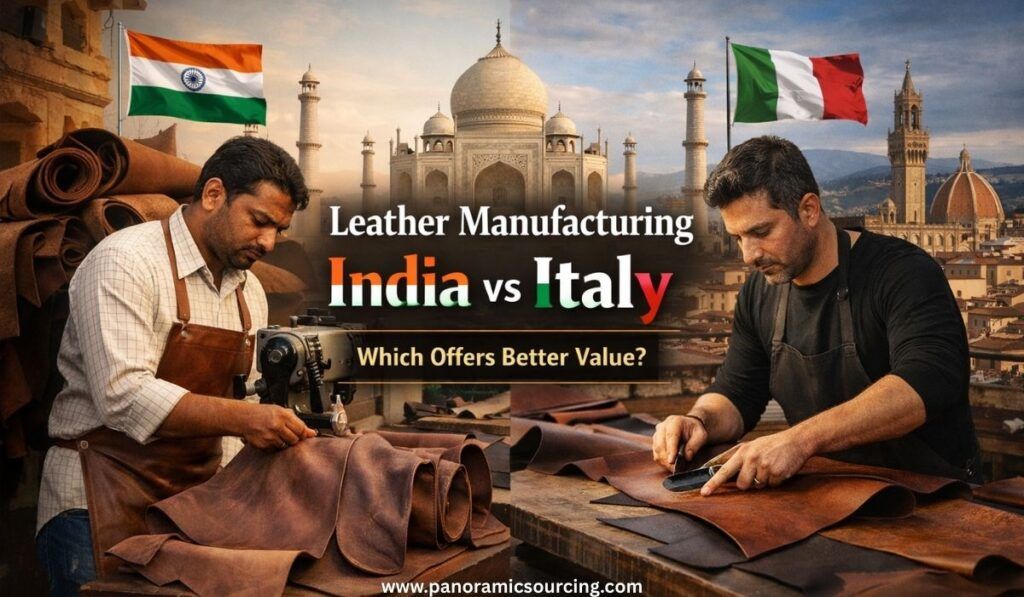
Leather Manufacturing India vs Italy: Which Offers Better Value?
If you ask a luxury designer in Milan where the world’s best leather comes from, they’ll point to the Arno Valley. If you ask a high-volume retail buyer in London where the future of the industry is heading, they’ll show you a sample from a workshop in Chennai. The debate over Leather Manufacturing India vs Italy isn’t just about geography; it’s about a massive shift in the global definition of “value.”
For a long time, the choice was simple: you went to Italy for status and India for price. But in 2026, that boundary has blurred. Italy is struggling with a shrinking artisan workforce and skyrocketing overheads, while India has spent the last decade upgrading its tanneries to meet European REACH standards. When you weigh up Leather Manufacturing India vs Italy, you’re actually deciding between a legacy that is pricing itself out of the market and a rising power that has finally mastered the art of “affordable luxury”.
1. The Craftsmanship Myth: Heritage vs. Innovation
Italy has the “Made in Italy” stamp, which is basically the gold standard for marketing. Their vegetable-tanned leathers are legendary for a reason. But here’s the reality: much of the “Italian” leather today is actually processed by workers who aren’t Italian. The soul of the industry is changing. When comparing Leather Manufacturing India vs Italy, people often overlook that India has a generational craft heritage that is just as deep.
In hubs like West Bengal and Uttar Pradesh, leather working isn’t just a job; it’s a family trade that goes back centuries. The difference is that Indian artisans are now using Italian-made machinery and chemicals. You’re getting the “Italian finish” at an “Indian cost”. If you put a premium Indian buffalo-hide bag next to a mid-range Italian calfskin bag, the average consumer—and even many experts—can’t tell the difference in the stitch. This is why the value proposition in Leather Manufacturing has swung so hard toward the subcontinent.
2. The Math of 2026: Tariffs and the FTA
This year, the entire landscape of leather manufacturing India vs Italy changed because of the India-EU Free Trade Agreement. Historically, Indian leather faced an 8-12% duty entering Europe. As of early 2026, those tariffs have been slashed. This means the “Value” gap has widened even further. This shift in global sourcing economics is also reflected in international trade policy trends tracked by the World Trade Organization.
If you are a European brand, sourcing from Italy means paying Euro-zone labor rates and 22% VAT. Sourcing from India now means 0% duty on many finished goods and a labor cost that is roughly 70% lower. When you calculate the total landed cost of leather manufacturing India vs Italy, India isn’t just a “cheaper alternative”—it’s a financial necessity for any brand that wants to maintain a margin without charging $2,000 for a tote bag.
3. Scale and Flexibility: The MOQ Battle
Italy is built on small, family-run ateliers. That’s great for a 50-piece runway collection, but it’s a nightmare when you need to scale to 5,000 units for a global holiday launch. Italian factories are notorious for long lead times and “take it or leave it” attitudes.
In the leather manufacturing India vs Italy standoff, India wins on pure muscle. The production scale in India is massive, yet the factories remain surprisingly flexible. You can find a Tier-1 factory in Noida that will work with a 100-unit MOQ for a startup but can scale to 50,000 units the next month. This agility is the true meaning of value. You aren’t just paying for the leather; you’re paying for the ability to grow your business without hitting a production ceiling.
4. Sustainability: The New Benchmark
Italy used to claim the moral high ground on eco-friendly leather. Their “Tuscan Vegetable Tan” was the ultimate eco-product. But India has caught up. The new tanneries in the Kolkata Leather Complex are among the most eco-compliant in the world, using advanced ZLD (Zero Liquid Discharge) systems.
When you look at Leather Manufacturing India vs Italy through a green lens, India often offers a more transparent “farm-to-finished” story. Because India has the world’s largest livestock population, the raw material is sourced locally, reducing the carbon footprint of transporting hides across oceans—something Italian tanneries (which often import raw hides from Brazil or the US) can’t say.
Why Panoramic Sourcing is Your Bridge to Indian Value
Making the jump from European production to an Indian factory is where most brands fail. They expect the “Italian way” of working but find a different cultural rhythm. That’s where Panoramic Sourcing comes in. We take the guesswork out of the Leather Manufacturing India vs Italy transition.
How We Deliver the “Best of Both Worlds”:
Design Sensitivity: We understand the “Italian aesthetic”—the thinness of the edges, the tone of the hardware, the suppleness of the grain. We find the Indian artisans who can replicate that high-end feel.
On-Ground Auditing: We don’t take a factory’s word for it. We are in the tanneries, checking the chrome levels and the stitching tension ourselves.
Cost Transparency: We ensure you get the benefit of the new 2026 trade deals. We don’t let “hidden costs” eat up the savings you expected when choosing India.
By choosing Panoramic Sourcing, you get the prestige-level finish that Italy is known for, but with the scalability and pricing that only India can provide.
Conclusion
Status is expensive. Quality doesn’t have to be. If your brand relies on the “Made in Italy” label to justify a 10x markup, then Italy is your home. But if your brand relies on providing the best possible product to a smart, value-conscious customer, the winner of Leather Manufacturing India vs Italy is clear.
India is no longer the “budget” option. It is the “smart” option. In 2026, the most profitable brands are those that have realized they can get Italian-quality leather with Indian-scale flexibility. The value is in the execution, not just the label.
FAQs
Is Italian leather inherently better quality than Indian leather?
Not anymore. While Italy leads in ultra-premium calfskin, India’s top-grain buffalo and goat leathers are now world-class and often more durable for everyday goods.
How much can I save by switching my Leather Manufacturing India vs Italy?
Most brands see a 40-60% reduction in total landed costs, especially with the new 2026 zero-duty trade agreements.
Can Indian factories handle high-end luxury finishes?
Yes. Many “Italian” luxury brands actually outsource their sub-assemblies to India because of the superior hand-embroidery and detailing skills available here.
What is the lead time difference in Leather Manufacturing India vs Italy?
Italy is often slower due to labor shortages. India’s massive workforce allows for faster sample turnarounds and bulk production timelines.
Are Indian tanneries as eco-friendly as Italian ones?
The top-tier, export-oriented tanneries in India are ISO and LWG certified, often exceeding the environmental standards of smaller, older Italian workshops.