
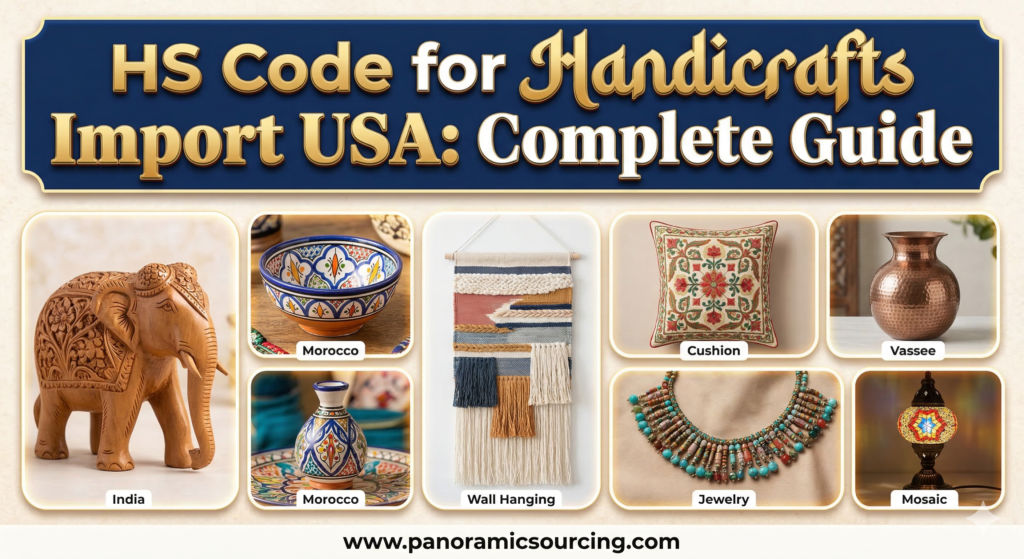
HS Code for Handicrafts Import USA: The Complete Guide
When you are looking to grow your retail business by bringing in unique, handmade items from India, the logistics can sometimes feel like a daunting puzzle. One of the most critical pieces of that puzzle is the HS Code for Handicrafts Import USA. This series of numbers is the universal language of global trade and getting it right is the difference between a shipment that clears customs in hours and one that gets stuck in a port for weeks.
At Panoramic Sourcing, we believe that your focus should be on the beauty and quality of the products you buy, not the stress of the paperwork. We act as your dedicated partner on the ground in India, ensuring that every item—from an intricate hand-carved wooden screen to a hand-beaten brass vase—is assigned the precise HS Code for Handicrafts Import USA. In the United States, this code forms the base classification, while the final duty rate is determined under the Harmonized Tariff Schedule of the United States (HTSUS).
Understanding the Role of the HS Code
The Harmonized System (HS) is a standardized numerical method of classifying traded products. It is used by customs authorities around the world to identify products for the application of duties and taxes. When we talk about the HS Code for Handicrafts Import USA, we are talking about a system that categorizes goods based on what they are made of and how they are used.
Accuracy here is non-negotiable. It is important to remember that the importer of record remains legally responsible for using the correct HS Code for handicrafts import USA, even when working with sourcing agents or customs brokers. An incorrect code can lead to overpaying on duties or, worse, facing “misclassification” penalties from US Customs and Border Protection.
Why “Handicrafts” Requires Specialized Knowledge
A common hurdle for many importers is the realization that “Handicrafts” is not a standalone category in the eyes of the US government. You cannot simply list “Handicrafts” on your commercial invoice and expect a smooth entry. Instead, the HS Code for Handicrafts Import USA is determined by the specific material composition of the item.
For example, a decorative bowl isn’t just a bowl. If it is made of mango wood, it has one code. If it is made of solid brass, it has another. This is where Panoramic Sourcing adds the most value. We don’t just look at the finished product; we look at the raw materials and the artisan’s process to ensure the classification is a perfect match for the physical goods.
Common HS Code Categories for Indian Handicrafts(Indicative)
To help you plan your next collection, we have outlined the most frequent categories our clients use. While these codes are common, remember that the specific details of your product—such as the type of wood or the weight of the metal—can shift the classification.
| Product Type | Product Description | Common HS Code | Typical US Duty Range |
| Wooden Artware | Statuettes, boxes and carved decorative items | 4420.11 / 4420.19 | 0% – 3.2% |
| Brass & Copper | Vases, traditional bells and statues | 7419.80 / 8306.29 | 0% – 3% |
| Iron Decor | Lanterns, wall art and garden décor items | 7326.90 / 7323.99 | 0% – 2.9% |
| Natural Fibers | Jute, bamboo, or seagrass basketry | 4602.11 / 4602.19 | 0% – 9% |
| Stone Crafts | Marble inlay work or stone carvings | 6802.91 / 6815.99 | 0% – 4.9% |
| Artistic Ceramics | Hand-painted pottery and figurines | 6913.10 / 6913.90 | 0% – 5% |
| Textile Decor | Hand-knotted rugs and wall hangings | 5701.10 / 6304.92 | 0% – 6.8% |
Note: Final tariff classification and applicable duty rates are determined by US Customs and may vary depending on material composition, manufacturing details, country of origin and current trade regulations.
Importers can verify Tariff classifications and applicable duty rates using the official HTSUS tariff database maintained by the U.S. International Trade Commission..
The “Essential Character” Rule
Often, Indian handicrafts are “mixed media”—they might combine wood with metal inlay or glass with iron frames. In these cases, how do you choose the right HS Code for Handicrafts Import USA?
US Customs follows the “Essential Character” rule. This means the classification is based on the material that gives the item its primary identity or utility. If you are importing a wooden jewelry box with a small decorative brass latch, the essential character is wood. However, if the box is completely covered in embossed brass sheets, the classification might shift to metal. At Panoramic Sourcing, we perform physical inspections to verify these details, ensuring your paperwork matches the “Essential Character” of the product.
Navigating the Lacey Act and Environmental Compliance
When dealing with the HS Code for Handicrafts Import USA, it isn’t just about the tax; it’s also about legal compliance. Many Indian handicrafts are made from wood, such as Sheesham, Mango, or Acacia. Products made from plant-based materials like these may require Lacey Act declarations depending on the species and the product’s construction.
This is a mandatory filing that confirms the wood species and ensures it was harvested legally. We handle this technical documentation at the source. By identifying the correct HS Code for handicrafts import USA early on, we can prepare the necessary plant product declarations so your shipment isn’t flagged for environmental review.
Calculating Your True Landed Cost
The primary reason our clients care about the HS Code for Handicrafts Import USA is to understand their “Landed Cost.” This is the total price of the product by the time it reaches your warehouse. It includes the ex-factory price, international freight, customs brokerage fees, and the duties.
Because India holds a “Most Favored Nation” (MFN) status with the USA, duties usually range between 0% and 8%, depending on the product category and material. However, if the wrong HS Code for handicrafts import USA is used, you could accidentally be charged a much higher rate intended for industrial or machine-made goods.
The Value of a Sourcing Partner in India
Managing the HS Code for Handicrafts Import USA from thousands of miles away is difficult. When you work with Panoramic Sourcing, you get a team that understands both the craft and the code. We provide pre-shipment material audits, document accuracy for your commercial invoices, and direct liaison support to ensure your shipment clears customs quickly.
Conclusion
By understanding the “Essential Character” of your goods and staying ahead of environmental regulations like the Lacey Act, you protect your investment from unexpected delays. At Panoramic Sourcing, we’re here to handle that technical heavy lifting. We bridge the gap between the artisan’s workshop and your warehouse, ensuring that every shipment is categorized correctly from day one. When your logistics are seamless, you can get back to what matters most: curating beautiful products that your customers will love.
FAQs
1. Can I use one general HS code for a mixed container of handicrafts?
No, every unique product type in your shipment must have its own specific HS Code for Handicrafts Import USA.
2. Do I need a special license to import handicrafts from India?
While you don’t need a “handicraft license,” you must have a valid Tax ID or Social Security number to act as the Importer of Record.
3. How often do these codes change?
The international HS system is updated every five years, but US-specific duty rates can be adjusted more frequently based on trade policy.
4. Does the age of the item affect the HS code?
Yes, items over 100 years old may qualify as “Antiques” under a different code, which is often duty-free.
5. Is the HS code the same for shipping to the UK?
The first six digits are globally harmonized, but the final digits and duty rates will differ from the USA.