
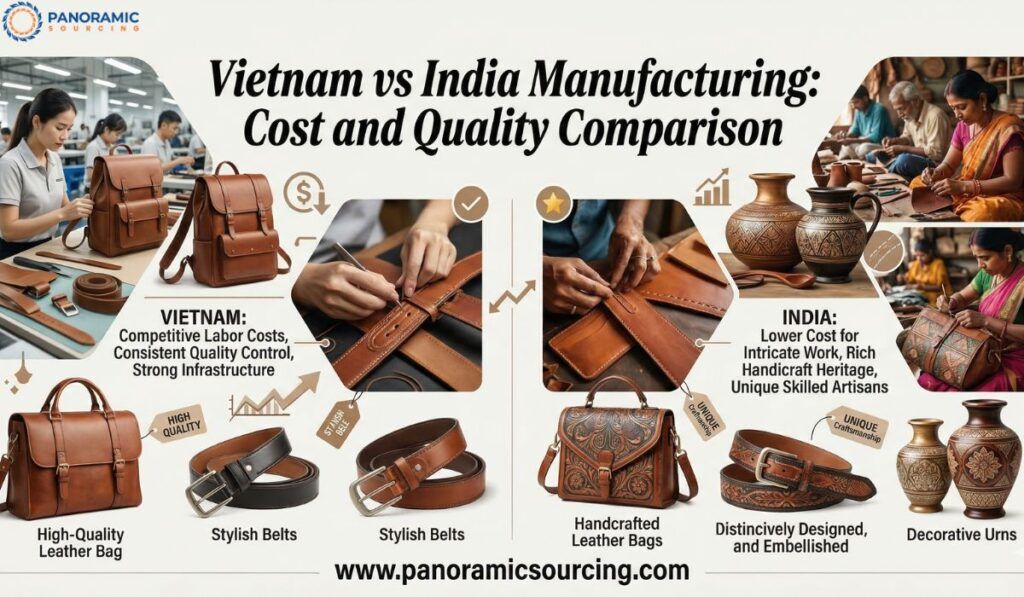
Vietnam vs India Manufacturing: Cost and Quality Comparison
In the high-stakes supply chain landscape of March 2026, the “China Plus One” strategy is increasingly shaping sourcing decisions for global retailers and Amazon sellers. For global retailers and Amazon FBA sellers, the Vietnam vs India Manufacturing comparison has become a key strategic decision for many brands planning their 2026 sourcing roadmap. It’s no longer just about who has the cheapest labor—it’s about whose logistics infrastructure and compliance readiness can better support long international shipping cycles and evolving sustainability audits.
Deciding on Vietnam vs India manufacturing requires looking past the glossy brochures. Vietnam is widely recognized for efficient large-scale assembly operations, while India is known for its vertically integrated material and craft ecosystems. As we navigate the trade complexities of this year, the choice between these two giants has evolved from a simple cost-comparison to a strategic alignment of your product’s DNA with a country’s industrial soul.
The Labor Trap: Cost vs. Retention in 2026
When brands talk about Vietnam vs India manufacturing, they usually start with hourly wages. In 2026, In many sectors, labor costs in India can be lower than in Vietnam, although actual savings depend on productivity and skill requirements. However, “cheap labor” is a mirage if your attrition rate is through the roof. Vietnam currently boasts much higher worker retention and a more disciplined industrial culture, especially in the electronics and footwear sectors.
In a Vietnam vs India manufacturing cost analysis, you have to factor in the “Efficiency Tax.” Vietnam’s workforce is highly specialized in high-speed, repetitive assembly. India’s workforce, while cheaper per hour, often requires more intensive on-ground management to reach the same output per man-hour. However, for complex handicrafts or embellished textiles, the Indian artisan’s “Tribal Knowledge” provides a value-per-dollar that Vietnam’s workforce structure is typically geared toward standardized, high-volume production environments.
Quality Systems: The “SOP” vs. The “Craft”
The Vietnam vs India manufacturing quality divide is a choice between a system and a skill. Vietnam has essentially “imported” the Chinese manufacturing SOP (Standard Operating Procedure). When you walk into a factory in Hai Phong, you see a clone of a Shenzhen facility: high-speed automation, rigid QC checkpoints and millimetric precision. It is perfect for “Basic-to-Mid” complexity goods where consistency is king.
India, conversely, wins on “Material Depth.” In the Vietnam vs India manufacturing quality race, India has a strong global reputation in textiles, leather and handcrafted metal products. Why? Because India owns the raw materials. From the cotton fields of Gujarat to the tanneries of Kanpur, the proximity to raw material sources can support better traceability and material control. While Vietnam relies on importing 70% of its raw materials from China, India’s vertical integration means your quality control starts at the source, not just at the final stitch.
Logistics: The Suez Reality and 2026 Shipping
Speed-to-market is the heartbeat of modern retail. As brands rethink production locations and adopt broader Supply Chain Resilience Strategies(SCRI), manufacturing decisions between countries like Vietnam and India are becoming more strategic than ever. A container from Ho Chi Minh City usually hits the US West Coast faster than one from Mumbai. But the gap is closing.
India’s “Gati Shakti” initiative has finally started showing teeth. By mid-2026, the new freight corridor projects are helping improve inland transport efficiency across key manufacturing regions. More importantly, for the European market, the Vietnam vs India manufacturing logistics map favors India. With the finalization of the ongoing trade negotiations between India and the EU are expected to influence future duty structures., Indian exporters now have a massive duty advantage and a shorter sea-lane to the EU, making India the smarter “Near-Sourcing” play for Western brands.
Scaling with Flexibility: The MOQ Barrier
For D2C startups and boutique brands, Vietnam vs India manufacturing often comes down to the Minimum Order Quantity (MOQ). Vietnam’s industrial parks are geared for “Scale.” If you aren’t ordering 1,000 units per style, some large Vietnamese manufacturers tend to prioritize higher-volume production orders. They are built for the Nike’s and Samsung’s of the world.
India is often preferred for smaller production batches and pilot runs. The fragmented nature of Indian manufacturing—scattered across thousands of specialized SMEs—allows for MOQs as low as 100 or 200 units. For a brand testing a pilot collection in 2026, the Vietnam vs India manufacturing choice is clear: India allows you to fail fast and pivot without losing your entire inventory budget. You can test five designs in India for the capital cost of one large run in Vietnam.
Regulatory Compliance: The 2026 Audit
Navigating the paperwork of Vietnam vs India manufacturing is like learning two different languages. Vietnam is incredibly efficient at the top level, with regulatory reforms in Vietnam continue to improve labor documentation transparency for international audits. This makes social audits (BSCI/SEDEX) much easier to clear for high-compliance brands.
India is more “Gritty” but offers higher strategic “Scale.” The Indian government’s PLI (Production-Linked Incentive) schemes have created massive tax breaks for those willing to commit to long-term manufacturing. In the Vietnam vs India manufacturing struggle for transparency, policy initiatives aimed at attracting foreign investment are contributing to gradual modernization of manufacturing facilities in India.
Panoramic Sourcing: Your Strategic Eyes in India
This is where Panoramic Sourcing bridges the gap. While the Vietnam vs India manufacturing debate rages on, we focus on making the “India Advantage” a reality for your brand. Based in Greater Noida, we don’t just “source suppliers”; we manage the factory floor.
At Panoramic Sourcing, we specialize in the product categories where India is often considered highly competitive: Leather Goods, Metal Handicrafts, Wooden Furniture and Fashion Accessories. We know that the Vietnam vs India manufacturing choice for these artisan-heavy categories isn’t even a contest—India owns the craftsmanship. We handle the unannounced QC visits, the raw material testing and the 2026 “Plastic-Free” packaging compliance so your goods arrive retail-ready.
Conclusion
The Vietnam vs India manufacturing decision isn’t about which country is “better”—it’s about which country matches your SKU list. If you are building high-volume, low-margin basics or electronics, Vietnam’s assembly lines are unbeatable. But if your brand stands for quality, material traceability and artisanal soul, India may be a suitable manufacturing partner for brands focused on craftsmanship and material depth.
The smartest brands in 2026 are diversifying across both. However, to win in India, you need on-ground muscle to navigate the “Scale vs. Productivity” gap. Panoramic Sourcing provides that expertise, helping brands navigate supplier coordination and production management more efficiently. Let’s build your 2026 collection in the heart of India’s manufacturing clusters.
FAQs
1. Which country is cheaper for labor in the Vietnam vs India manufacturing debate?
India is roughly 30% cheaper for raw labor, but Vietnam often yields higher productivity per man-hour in electronics assembly.
2. Does Vietnam have better export duties for the EU?
Vietnam’s EVFTA is strong, but the new India-EU FTA (signed Jan 2026) has leveled the playing field for Indian exporters.
3. Can I source sustainable materials more easily in India or Vietnam?
India is superior for sustainable textiles (organic cotton/jute) because it produces the raw materials domestically, ensuring full traceability.
4. What is the typical MOQ difference between Vietnam and India?
Vietnam usually requires 500–1,000 units per style, while Indian factories are often willing to start at 100–200 units.
5. How does Panoramic Sourcing help manage Vietnam vs India manufacturing risks?
We act as your on-ground QC team in India, ensuring that Indian craftsmanship meets the rigid “Systematic Quality” standards of Vietnamese factories.