
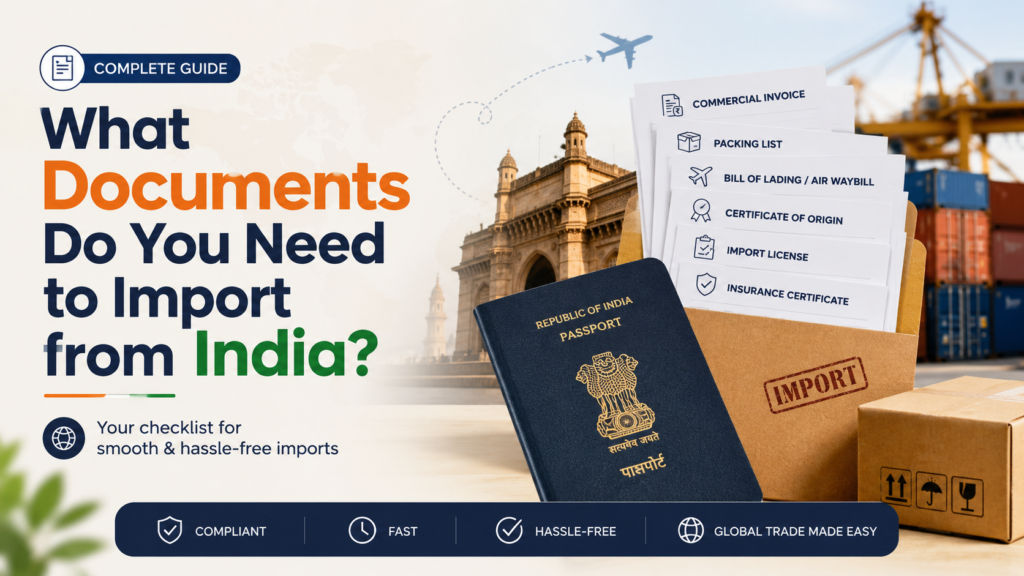
What Documents Do You Need to Import from India
If you are searching for documents needed to import from India, you are likely trying to avoid costly delays, customs objections, or shipment holds. The good news is that most import transactions follow a clear paperwork process, and once you know the basic requirements, importing becomes much smoother.
Whether you are buying handcrafted items, home furnishings, leather goods, or fashion accessories, the right import documents help your shipment move through customs without unnecessary friction. In this guide, we will explain the essential papers, the product-specific requirements, and the documents that matter most for customs clearance in India.
Why Import Documents Matter
Import documentation is not just a formality. It is the foundation of international trade compliance, customs valuation, and smooth cargo release. Missing or incorrect paperwork can lead to delays, penalties, inspection issues, or even shipment rejection.
For global buyers, import documents also serve as proof of what you bought, who shipped it, what it is worth, and whether it meets the legal requirements of the destination country. That is why knowing the requirements to import goods is essential before placing an order.
Basic Documents Needed to Import from India
The exact paperwork may vary depending on product type, destination country, and shipping terms, but the following are the most common import documents India shipments require.
1. Commercial Invoice
The commercial invoice is one of the most important documents in any import shipment. It shows the buyer and seller details, product description, quantity, unit price, total value, currency, and payment terms.
Customs authorities use this document to assess duty and verify the declared value of the goods. If the invoice is unclear or incomplete, clearance may be delayed.
2. Packing List
The packing list explains how the shipment is packed. It usually includes carton count, dimensions, gross weight, net weight, and product details inside each package.
This document helps customs, freight forwarders, and warehouse teams identify the cargo correctly. It is especially useful when goods are consolidated or when multiple SKUs are shipped together.
3. Bill of Lading or Airway Bill
This is the transport document issued by the carrier or freight forwarder. For sea shipments, it is called a Bill of Lading. For air shipments, it is called an Airway Bill.
It acts as proof that the shipment has been dispatched and contains details about the route, consignee, and cargo reference. For many importers, this is one of the core items in the export- import documents list as well.
4. Insurance Certificate
If the shipment is insured, the insurance certificate provides proof of cargo coverage during transit. This document may be required by customs or requested by the importer for risk management.
It is especially important when goods are shipped under CIF terms or when the cargo is valuable or fragile.
5. Bill of Entry
The Bill of Entry is a customs declaration filed in the importing country. It is a key document for customs clearance and duty calculation.
In India, the CHA or customs broker usually files this electronically. For importers asking what documents are required for customs clearance in India, the Bill of Entry is one of the most important answers.
6. Importer Exporter Code (IEC)
The IEC is a unique business identification number required for import and export in India. If you are importing goods from India as a foreign buyer, your local import registration or tax identification may be needed in your own country instead.
For Indian exporters, IEC is often part of the compliance set that supports smooth shipping and documentation.
7. GSTIN and Business Registration Documents
For Indian companies involved in import-export trade, GSTIN and business registration details may be requested during compliance checks. These documents help verify the legal identity of the importer or exporter.
If you are planning to build a trade business, you may also want to understand the documents required to start import export business in India before beginning operations.
Product-Specific Import Requirements
Some products need additional approvals, certifications, or permits. This is where many importers run into trouble, because the paperwork is not always the same for every category.
Handicrafts and Home Furnishings
These products usually need the standard commercial documents, but some countries may request origin-related paperwork or material composition details. If the item includes wood, natural fibers, or animal-based materials, extra compliance checks may apply.
Leather Goods
Leather products may require declarations related to material source, fumigation, or labeling standards depending on the destination market. Importers should confirm product rules before shipment.
Fashion Accessories
Accessories made from metal, plastic, stones, fabric, or mixed materials may need testing, labeling, or product safety declarations. This is common when importing into regulated markets.
Restricted or Regulated Goods
Some categories may need special approvals such as BIS, FSSAI, WPC, CDSCO, PESO, or plant quarantine documents depending on the product and destination. These are not always needed, but they must be checked in advance.
Documents Buyers Should Ask For
If you are sourcing from India, your supplier should ideally provide a clean and complete document set before shipment. At minimum, ask for:
Commercial Invoice.
Packing List.
Bill of Lading or Airway Bill.
Insurance Certificate, if applicable.
Certificate of Origin, if needed.
Product-specific certificates, if applicable.
Bill of Entry or customs filing documents in the destination country.
Any inspection report or lab test report required by the market.
This list is especially useful if you are comparing the list of documents required for import across different products or trade lanes.
Documents for Customs and Compliance
Many first-time importers search for what documents are required for customs clearance in India, but the better question is: which documents does your shipment need to pass through customs smoothly in the destination country?
The answer depends on three things:
Product category.
Shipping method.
Import regulations in the buyer’s country.
In most cases, customs wants to see proof of value, proof of shipment, proof of origin, and proof of compliance. When these four things are clear, clearance becomes much easier.
Common Mistakes Importers Make
Even experienced importers make paperwork mistakes. The most common ones include:
Invoice and packing list do not match.
Product description is too vague.
HS code is missing or incorrect.
Declared value is unrealistic.
Missing origin certificate for preferential duty claims.
Missing product compliance certificate.
Importer name on documents is inconsistent.
A small mismatch can create a big delay, so document accuracy should always be checked before dispatch.
Documents for Export From India
Although this blog focuses on importation, many buyers also ask about the list of documents required for export from India. The exporter’s document set usually overlaps with import paperwork and includes invoice, packing list, shipping bill, transport documents, and product-specific certificates.
For this reason, many businesses keep one shared list of documents required for import and export workflows so the trade process stays consistent across shipments.
How Panoramic Sourcing Helps Global Buyers
At Panoramic Sourcing, we work with global buyers who source handcrafted items, home furnishings, leather goods, and fashion accessories from India. We help our clients manage product sourcing, supplier coordination, shipping readiness, and document alignment so the shipment is prepared for smoother trade handling.
If you are buying from India for the first time, or if you want a reliable sourcing partner that understands compliance and buyer expectations, our team can support you from supplier identification to export-ready documentation.
FAQ
What documents are needed to import from India?
The most common documents needed to import from India are the commercial invoice, packing list, Bill of Lading or Airway Bill, insurance certificate, and customs declaration papers. Depending on the product, you may also need origin certificates or regulatory approvals.
What documents are required for customs clearance in India?
For customs clearance, the key documents usually include the commercial invoice, packing list, transport document, Bill of Entry, and any product-specific approvals. Customs may also ask for supporting compliance documents depending on the goods.
What is the most important import document?
The commercial invoice is one of the most important documents because it helps customs determine the product value, duty, and shipment details. The packing list and transport document are equally important for cargo verification.
Do all products need the same import documents?
No, import documents vary by product type. Standard shipments need basic trade documents, but regulated products may require additional certificates, licenses, or inspections.
What documents are required to start import export business in India?
The basic documents include business registration, PAN, GST registration, IEC, bank details, and other compliance papers depending on the business structure. These documents are part of the wider documents required to start import export business in India checklist.
Is a certificate of origin always needed?
No, a certificate of origin is not always mandatory. It is usually required when the buyer wants to claim preferential duty benefits under a trade agreement or when the importing country asks for origin proof.
Conclusion
Understanding the documents needed to import from India is one of the fastest ways to reduce delays, protect your shipment, and improve buyer confidence. When your invoice, packing list, transport papers, and compliance documents are properly prepared, customs clearance becomes much more efficient.
For global buyers sourcing handcrafted items, home furnishings, leather goods, and fashion accessories, documentation is not just paperwork—it is part of a professional, low-risk supply chain. Panoramic Sourcing helps international clients source with confidence, communicate clearly with suppliers, and prepare export-ready shipments that support smooth imports worldwide.