
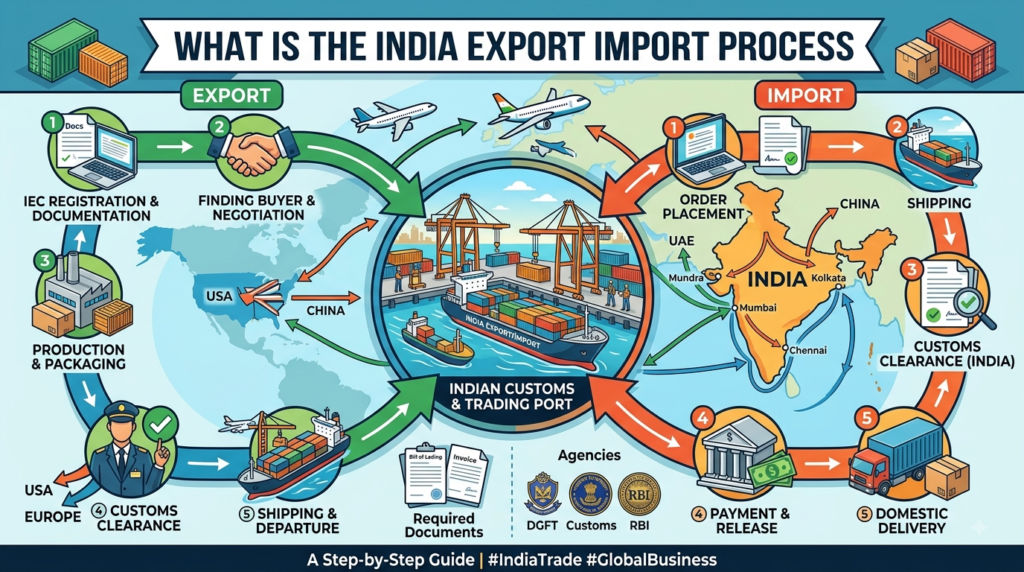
What Is the India Export Import Process?
If you’re looking to source products from India or ship goods in and out of the country, understanding the India export import process is essential. This guide breaks down the procedure of import and export in simple, practical steps—covering everything from licensing and documentation to shipping, customs clearance, and compliance. Whether you’re a global buyer, an importer, or an exporter, this overview will help you navigate international trade with confidence.
Why the India Export Import Process Matters for Global Buyers
India is a leading sourcing destination for handcrafted items, home furnishings, leather goods, and fashion accessories. But moving goods across borders involves regulations, paperwork, and timelines that can delay shipments if not handled correctly. Knowing the import export India workflow helps you:
Avoid customs hold-ups and penalties
Plan realistic lead times and budgets
Work smoothly with suppliers, freight forwarders, and customs brokers
Ensure compliance with Indian and destination-country rules
For Panoramic Sourcing, this knowledge is part of our daily operations. We support global clients end-to-end so you can focus on growing your brand while we manage the complexities of cross-border trade.
Step-by-Step: The India Export Import Process Explained Simply
India export import process, aligned with current DGFT and customs requirements.
1) Obtain the Importer-Exporter Code (IEC)
Every business engaged in cross-border trade must have an Import Export Code (IEC) issued by the Directorate General of Foreign Trade (DGFT). This is a one-time, lifetime registration linked to your PAN. Without an IEC, you cannot file shipping bills (for exports) or bills of entry (for imports).
How it works:
Apply online via the DGFT portal
Submit required KYC and business documents
Receive your IEC digitally once approved
At Panoramic Sourcing, we ensure all our export shipments are IEC-compliant from day one.
2) Classify Your Product (HS Code) and Check Policy
Every product has a Harmonized System (HS) code that determines duty rates, restrictions, and required licenses. Using the correct HS code is critical—mistakes can lead to customs queries, extra duties, or shipment delays.
What to do:
Identify the 6–8 digit HS code for your product
Check the DGFT’s ITC (HS) schedule to confirm if the item is “Free,” “Restricted,” or “Prohibited”
Verify if any additional licenses or certificates are needed (e.g., textile quotas, food safety approvals)
3) Finalize Commercial Terms (Incoterms)
Agree on Incoterms (e.g., FOB, CIF, EXW) with your supplier or buyer. This defines who pays for freight, insurance, and where risk transfers. Clear terms prevent disputes and ensure smooth logistics.
Tip: For global buyers sourcing from India, FOB (Free on Board) is common—you control freight and insurance from the Indian port onward.
4) Prepare Core Export/Import Documentation
Documentation is the backbone of the import export documentation process in India. Missing or inconsistent papers are the top cause of customs delays.
Key export documents:
Commercial Invoice
Packing List
Shipping Bill (filed on ICEGATE)
Bill of Lading (sea) or Airway Bill (air)
Certificate of Origin (if required by the buyer’s country)
Inspection/Quality certificates (if applicable)
AD Code letter from your bank (for export proceeds realization)
Key import documents (for goods entering India):
Bill of Entry
Commercial Invoice cum Packing List
Bill of Lading/Airway Bill
IEC Code
Any product-specific licenses or NOCs
5) Pre-Shipment Inspection and Quality Checks
Many international buyers request pre-shipment inspection to verify quality, quantity, and packaging before goods leave the factory. This step reduces returns and claims.
Best practice:
Define inspection criteria in your purchase order
Use a third-party inspection agency if needed
Share the inspection report with your freight forwarder and customs broker
6) File Shipping Bill / Bill of Entry and Clear Customs
For exports, your customs broker files the Shipping Bill on ICEGATE. For imports, they file the Bill of Entry. Customs assesses duties, may examine the cargo, and issues clearance once everything matches.
What happens next:
Cargo is examined (if selected)
Duties and taxes are paid (for imports)
Customs issues “Let Export Order” (exports) or “Out of Charge” (imports)
Goods are loaded onto the vessel/aircraft or released to the importer
7) Ship the Goods and Share Documents
Once customs clears the shipment, the carrier issues the Bill of Lading or Airway Bill. You then share the full document set with the buyer (or their bank, if using LC) to enable payment and destination clearance.
Typical document flow:
Send scanned copies immediately for advance filing at destination
Dispatch originals via courier or through banking channels (as per payment terms)
8) Realize Export Proceeds and Claim Benefits (for Exporters)
After shipment, exporters must:
Submit shipping documents to their bank for export proceeds realization
File for GST refunds on zero-rated exports, if applicable
Claim export incentives under relevant schemes (if eligible)
Import Process Step by Step (For Buyers Bringing Goods into India)
If your business is importing into India, the import process step by step looks like this:
Obtain IEC from DGFT (mandatory for all importers)
Check import policy for your HS code (free/restricted/prohibited)
Finalize supplier terms and Incoterms; arrange LC or advance payment if required
Receive pre-shipment documents (invoice, packing list) and verify details
File Bill of Entry via your customs broker on ICEGATE once goods arrive
Pay customs duties and IGST as assessed
Undergo customs examination (if selected) and obtain “Out of Charge”
Take delivery from the port/airport and arrange inland transport
Import Export License Process in India: Do You Need One?
Most products fall under the “Free” category and only require an IEC. However, certain items need additional import export license process in India approvals, such as:
Textiles under quota
Pharmaceuticals and medical devices
Food and agricultural products
Chemicals and hazardous goods
How to check:
Use your HS code on the DGFT portal
Confirm if a specific license, registration, or NOC is mandatory
Apply through the relevant authority (DGFT, FSSAI, CDSCO, etc.) as needed
Panoramic Sourcing helps global clients verify these requirements before production begins, avoiding last-minute compliance surprises.
Common Pitfalls to Avoid in the India Export Import Process
Even experienced traders make mistakes. Here are the most common—and costly—errors to avoid:
Wrong or missing HS code: Leads to incorrect duties, delays, or seizures. Always validate HS codes before filing.
Inconsistent documents: Invoice, packing list, and shipping bill must match exactly (values, quantities, descriptions).
Skipping pre-shipment checks: Increases risk of quality disputes and returns.
Ignoring destination rules: Some countries require specific certificates (e.g., GSP, fumigation). Confirm buyer-country requirements early.
Late AD Code registration: Exporters must link their AD Code with customs ports to avoid payment delays.
Assuming “Free” means no rules: Even free-category items may need quality or safety certifications.
FAQs: India Export Import Process
1) What is the first step in the India export import process?
The first step is obtaining an Import Export Code (IEC) from DGFT. No shipment can be cleared without it.
2) Which documents are mandatory for exports from India?
Core export documents include the Commercial Invoice, Packing List, Shipping Bill, Bill of Lading/Airway Bill, and, where required, Certificate of Origin and inspection certificates.
3) How long does the import export license process in India take?
For most “Free” category goods, only the IEC is needed (processed in a few days). Product-specific licenses vary—some take days, others weeks. Always check your HS code on the DGFT portal.
4) What is the procedure of import and export for handcrafted and home décor items?
These typically fall under “Free” with standard documentation. However, materials like wood, leather, or metals may need additional certificates (e.g., fumigation, CITES, or material declarations). Work with a knowledgeable sourcing partner to confirm.
5) Can I start importing without an IEC?
No. Indian customs requires a valid IEC to clear imports. Apply online via DGFT before placing orders.
6) How does Panoramic Sourcing simplify the India export import process for global buyers?
We handle supplier vetting, quality checks, documentation, customs coordination, and logistics—so you receive compliant, on-time shipments without managing multiple vendors.
Conclusion: Make the India Export Import Process Work for Your Business
Understanding the India export import process isn’t just about compliance—it’s about speed, cost control, and reliability. From IEC registration and HS code classification to documentation, customs clearance, and shipping, each step impacts your lead times and margins.
For global buyers sourcing handcrafted items, home furnishings, leather goods, and fashion accessories, partnering with an experienced India-based team makes all the difference. At Panoramic Sourcing, we combine local market knowledge with export expertise to deliver smooth, predictable shipments worldwide.
Ready to streamline your sourcing from India? Talk to our team to align your product plans with the right compliance and logistics strategy from day one.