
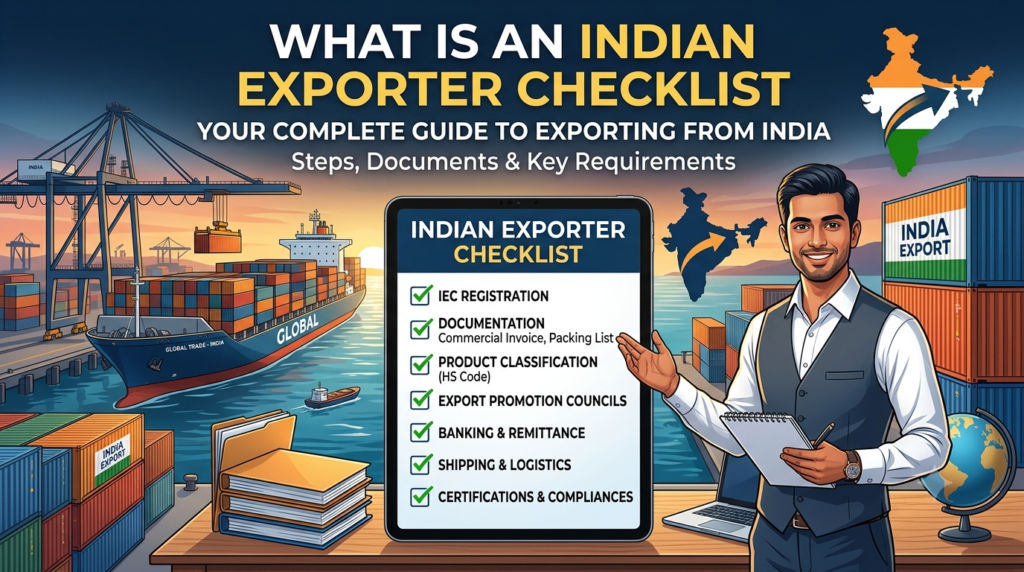
What Is an Indian Exporter Checklist?
Exporting products from India to international markets involves more than finding a buyer and arranging shipment. Before goods leave the country, an exporter needs to confirm that the business, product, documents, packaging, quality, compliance, and logistics are all ready.
An Indian exporter checklist provides a practical way to review these requirements before shipment and reduce the risk of documentation errors, customs delays, quality disputes, rejected shipments, or payment problems.
This guide focuses on exporter readiness in India. Instead of explaining the entire import-export process step by step, it gives Indian exporters a final readiness check before accepting, producing, packing, and shipping an international order.
Quick distinction: If you want to understand the complete import and export procedure in India, including IEC, HS codes, customs clearance, shipping, and import requirements, see our detailed guide to the India Export Import Process.
What Is an Indian Exporter Checklist?
An Indian exporter checklist is a structured list of items that an exporter should verify before shipping goods to an overseas buyer.
It covers areas such as:
- Business and export registration
- Product classification
- Buyer and order verification
- Commercial terms
- Export documentation
- Product compliance
- Quality inspection
- Packaging and labeling
- Shipping and customs readiness
- Payment and banking requirements
- Destination-country requirements
The purpose is simple: make sure nothing important is overlooked before the shipment reaches the port or airport.
A good checklist can be especially useful for manufacturers, trading companies, sourcing businesses, and new exporters entering international markets.
Indian Exporter Checklist: 10 Things to Check Before Shipment
1. Confirm Your Export Business Readiness
Before accepting an international order, confirm that your business has the basic registrations and banking arrangements required for exporting.
Business readiness checklist
☐ Valid Importer Exporter Code (IEC)
☐ PAN and applicable business registrations
☐ GST registration, where applicable
☐ Current bank account with an authorised dealer bank
☐ Export-related banking arrangements are in place
☐ AD Code requirements have been checked for the relevant customs location
The IEC is a fundamental requirement for businesses engaged in import or export activities in India. The exact requirements can vary depending on the product and transaction.
Do not assume that having an IEC alone means every shipment is ready. Product-specific regulations, licences, registrations, or certificates may also apply.
2. Verify the Product and HS Code
Correct product classification is one of the most important parts of exporter readiness in India.
Every product being exported needs to be classified under the appropriate HS/ITC-HS code. The classification can affect export policy, documentation, duties or taxes, and product-specific requirements.
Product classification checklist
☐ Product description is clear and accurate
☐ Correct HS/ITC-HS code has been identified
☐ Export policy for the product has been checked
☐ Product is not subject to an unexpected restriction or prohibition
☐ Required licences or approvals have been identified
☐ Product-specific certificates have been checked
☐ Material composition is clearly understood
This is particularly important for products such as leather goods, handicrafts, textiles, food products, chemicals, agricultural products, and items containing regulated materials.
Do not choose an HS code simply because it was used on an older shipment. Confirm that it matches the actual product being exported.
3. Confirm Buyer and Order Details
Export readiness starts before production.
An exporter should make sure that the commercial details agreed with the overseas buyer are clear and documented.
Buyer and order checklist
☐ Buyer/company details are verified
☐ Purchase order is received and reviewed
☐ Product specifications are confirmed
☐ Quantity is confirmed
☐ Price and currency are confirmed
☐ Payment terms are agreed
☐ Delivery timeline is agreed
☐ Shipping destination is confirmed
☐ Incoterm is clearly stated
☐ Special buyer requirements are documented
This helps prevent situations where the exporter produces the right quantity but the wrong specifications, packaging, labeling, or shipping configuration.
4. Review Incoterms and Commercial Terms
Before production or shipment, both parties should understand their responsibilities under the agreed Incoterm.
For example, the responsibilities under EXW, FOB, CIF, and other Incoterms can differ regarding transportation, insurance, costs, and transfer of risk.
Commercial terms checklist
☐ Incoterm is agreed
☐ Named place or port is clearly specified
☐ Freight responsibility is understood
☐ Insurance responsibility is understood
☐ Payment terms are documented
☐ Currency is confirmed
☐ Payment milestone dates are clear
☐ Any Letter of Credit requirements are reviewed
Clear commercial terms help prevent disputes between exporters, buyers, freight forwarders, and other parties involved in the shipment.
5. Prepare and Cross-Check Export Documents
Documentation is one of the most important parts of an Indian exporter checklist.
DGFT identifies core export documents including the transport document, Commercial Invoice cum Packing List, and Shipping Bill/Bill of Export. Additional documents can be required depending on the product and applicable regulations.
Export documentation checklist
☐ Commercial Invoice
☐ Packing List
☐ Shipping Bill/Bill of Export
☐ Bill of Lading or Airway Bill
☐ Certificate of Origin, where required
☐ Inspection/quality certificate, where required
☐ Export licence, where applicable
☐ Product-specific certificates, where applicable
☐ Insurance document, where applicable
☐ Banking/payment documents
☐ Buyer-specific documentation
Most importantly, check that the information is consistent across documents.
For example:
- Product description should match
- Quantity should match
- Invoice value should match
- Buyer/consignee details should match
- Package information should match
- HS code should be correctly declared where required
Small inconsistencies can create unnecessary questions during customs clearance or document review.
6. Check Product Compliance and Destination Requirements
An Indian exporter must consider not only Indian export requirements but also the requirements of the destination country.
A product that can legally be exported from India may still need to meet additional requirements in the buyer’s country.
Compliance checklist
☐ Indian export requirements checked
☐ Destination-country requirements checked
☐ Product safety requirements reviewed
☐ Labeling requirements reviewed
☐ Packaging requirements reviewed
☐ Material restrictions checked
☐ Required certificates identified
☐ Country-specific documentation confirmed
☐ Buyer/importer requirements confirmed
For certain products, additional requirements may apply. DGFT notes that specific goods can require additional documents, NOCs, or product-specific compliance depending on applicable regulations.
For this reason, exporters should not rely only on a general export checklist. Product and destination-specific requirements must also be verified.
7. Complete Quality Inspection Before Shipment
Export readiness is not only about paperwork.
The goods themselves should be checked before shipment, especially when the buyer has specific quality requirements.
A pre-shipment inspection can help identify defects before the goods leave the factory.
Quality readiness checklist
☐ Product specifications checked
☐ Quantity verified
☐ Dimensions checked
☐ Material verified
☐ Colour/finish checked
☐ Workmanship inspected
☐ Functional testing completed, where applicable
☐ Buyer-approved sample compared with production
☐ Carton quantity verified
☐ Final inspection completed
☐ Inspection report prepared, where required
For sourcing-intensive products such as handicrafts, leather goods, fashion accessories, and home furnishings, this stage can be particularly important because product variations may occur during production.
8. Check Packaging, Labeling, and Shipment Markings
Good products can still face problems if they are not packed appropriately for international transportation.
Packaging should protect the goods while also meeting the buyer’s requirements and any applicable destination-country rules.
Packaging checklist
☐ Export cartons are suitable for transportation
☐ Inner packaging is appropriate
☐ Product is protected against moisture/damage where necessary
☐ Carton dimensions are confirmed
☐ Gross and net weights are verified
☐ Number of cartons is confirmed
☐ Shipping marks are correct
☐ Buyer-required labels are included
☐ Product labels meet destination requirements
☐ Palletization requirements are checked
☐ Fumigation requirements are checked where applicable
For wood packaging materials, agricultural products, and certain other categories, additional requirements may apply depending on the shipment and destination.
9. Confirm Customs and Logistics Readiness
Before the cargo reaches the port or airport, make sure the logistics chain is ready.
Logistics checklist
☐ Freight forwarder is confirmed
☐ Customs broker/CHA is confirmed, where used
☐ Port or airport is confirmed
☐ Shipping schedule is confirmed
☐ Cargo pickup date is confirmed
☐ Customs filing timeline is confirmed
☐ Shipping Bill information is ready
☐ Cargo dimensions and weight are confirmed
☐ Container/pallet requirements are confirmed
☐ Cut-off dates are understood
☐ Buyer or importer has been informed of the shipping schedule
The Shipping Bill is a key part of the export customs process, and customs clearance must be completed before the goods can proceed for export.
Good coordination between the exporter, freight forwarder, customs broker, transporter, and buyer can significantly reduce last-minute problems.
10. Verify Payment and Post-Shipment Requirements
Exporter readiness does not end when the cargo is shipped.
The exporter should also make sure that post-shipment documentation and payment-related activities are completed.
Post-shipment checklist
☐ Final shipping documents received
☐ Bill of Lading/Airway Bill reviewed
☐ Documents shared with buyer
☐ Documents submitted to bank where required
☐ Export payment tracking arranged
☐ Export proceeds monitored
☐ GST refund/LUT requirements reviewed, where applicable
☐ Eligible export benefits reviewed
☐ Shipment records maintained
The exact banking and tax requirements can vary depending on the transaction structure, payment terms, and applicable regulations.
Indian Exporter Checklist: Final Pre-Shipment Review
Before releasing the shipment, use this quick final review:
Business
☐ IEC verified
☐ Banking arrangements ready
☐ AD Code requirements checked
Product
☐ Product specifications confirmed
☐ HS code verified
☐ Export policy checked
☐ Product-specific compliance checked
Commercial
☐ Purchase order confirmed
☐ Price and currency confirmed
☐ Incoterm confirmed
☐ Payment terms confirmed
Documentation
☐ Commercial Invoice ready
☐ Packing List ready
☐ Shipping Bill information ready
☐ Transport document requirements confirmed
☐ Certificate of Origin arranged if required
☐ Additional certificates arranged if required
Quality
☐ Production inspected
☐ Quantity verified
☐ Quality requirements met
☐ Buyer-approved sample matched
Packaging
☐ Packaging approved
☐ Labels checked
☐ Shipping marks checked
☐ Carton count and weights verified
Logistics
☐ Freight forwarder confirmed
☐ Customs broker confirmed
☐ Pickup scheduled
☐ Port/airport cut-off checked
☐ Shipping schedule confirmed
Post-Shipment
☐ Shipping documents shared
☐ Bank documentation completed where required
☐ Payment tracking arranged
☐ Export records maintained
Why Is Exporter Readiness Important in India?
A shipment can be delayed even when the product itself is ready.
Common problems include:
- Incorrect HS classification
- Missing documents
- Inconsistent invoice and packing-list details
- Incorrect packaging
- Missing certificates
- Unclear buyer requirements
- Late customs documentation
- Failure to check destination-country regulations
- Quality issues discovered after production
- Shipping cut-off dates being missed
A structured Indian exporter checklist gives businesses a repeatable process for identifying these issues before shipment.
Instead of checking everything at the last minute, exporters can build readiness into the order process from the beginning.
Indian Exporter Checklist vs. India Export Import Process
These two topics are related, but they serve different purposes.
The India Export Import Process explains how importing and exporting works, including registration, classification, documentation, customs, shipping, and post-shipment activities.
The Indian exporter checklist is more practical. It asks:
“Have I completed everything necessary to make this particular export shipment ready?”
You can use the two resources together:
Learn the process → Prepare the shipment → Run the checklist → Ship with confidence
For a detailed explanation of the overall process, read our guide to the India Export Import Process.
How Panoramic Sourcing Supports Exporter Readiness in India
For international buyers sourcing from India, exporter readiness often begins with selecting the right supplier and verifying that the supplier can meet the required product, quality, documentation, and shipment requirements.
Panoramic Sourcing supports global buyers with activities such as supplier verification, product sourcing, quality inspection, documentation coordination, and export logistics support.
This can help buyers reduce the risks associated with working with unfamiliar suppliers and managing multiple stages of an India sourcing order.
For exporters and suppliers, having a structured readiness process can also help create more predictable shipments and smoother communication with international buyers.
Conclusion
An Indian exporter checklist is a practical tool for making sure an export shipment is ready before it leaves India.
The most important areas to review are:
- Business and registration readiness
- Product and HS code verification
- Buyer and order details
- Commercial terms
- Export documentation
- Product and destination compliance
- Quality inspection
- Packaging and labeling
- Customs and logistics
- Payment and post-shipment requirements
The goal is not simply to complete paperwork. Exporter readiness in India means making sure the product, documents, compliance, quality, packaging, logistics, and commercial requirements all work together before shipment.
For a complete explanation of the broader import and export procedure, refer to our India Export Import Process guide. This checklist can then be used as a practical final review before an export shipment moves forward.