
Customs Clearance for Imports from India: A Quick Guide
If you plan to source goods from India, understanding customs clearance import from India is essential to avoid delays, unexpected costs, and compliance headaches. At Panoramic Sourcing, we help global buyers navigate customs India imports from start to finish—handling paperwork, advising on duties and HS codes, coordinating inspections, and ensuring your handcrafted items, home furnishings, leather goods, and fashion accessories clear quickly and legally.
Why customs clearance matters for imports from India
Customs clearance is the official process that allows goods to cross borders after meeting legal, tax, and regulatory requirements. For importers, smooth customs clearance import from India reduces landed cost surprises, speeds delivery, and prevents fines. Whether you import leather products, home décor, or fashion accessories, customs rules shape your profitability and delivery timelines. That’s why buyers who work with an experienced sourcing partner see fewer hold-ups and more predictable supply chains.
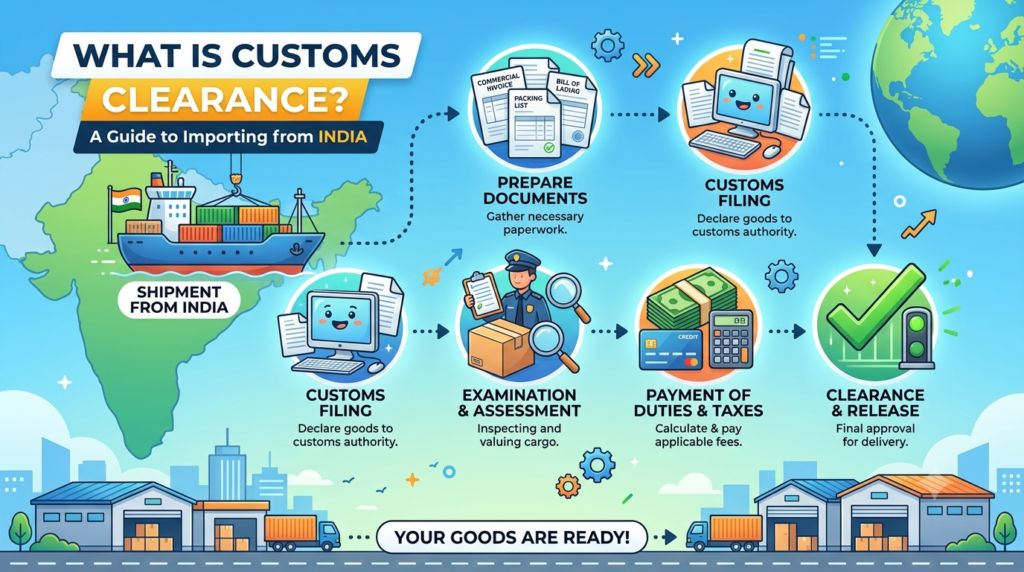
Quick overview of the clearance steps
Document preparation: commercial invoice, packing list, bill of lading or airway bill, certificate of origin, and product-specific certificates (for example, leather treatment or fumigation for wooden items). These are the primary custom clearance documents for import.
Filing the customs declaration: your importer or customs broker submits electronic declarations to the destination country’s customs authority.
Duties and taxes: customs calculates applicable import duty, GST/VAT, and local fees based on the HS code and declared value.
Inspection & examination: customs may select shipments for physical inspection, X-ray screening, or lab testing.
Release & delivery: after payment and clearance, goods are released for delivery to your warehouse.
If you searched “customs clearance import from India” because you need a reliable partner to handle documentation, duties, and clearance timelines, Panoramic Sourcing is here to help — we specialize in global shipments of handcrafted items and fashion accessories and manage every step of customs India imports so your cargo moves efficiently from supplier to customer.
What documents are required for customs clearance in India
Commercial invoice: seller/buyer details, item description, unit price, total value.
Packing list: package counts, weights, and dimensions.
Bill of Lading (ocean) or Airway Bill (air).
Certificate of Origin: sometimes required for preferential duty treatment.
Insurance certificate: if insurance is part of the sale.
Product-specific certificates: leather treatment certificates, phytosanitary or fumigation certificates for wooden products, safety test reports for toys.
Importer Exporter Code (IEC) or local import licenses (for the importer).
Preparing these documents accurately avoids the most common delays in the customs clearance process in India.
How customs decides duties: HS codes and valuation
Customs uses Harmonized System (HS) codes to classify goods and determine duty rates. Valuation typically follows CIF or FOB rules depending on your Incoterms, and customs applies valuation rules to calculate taxes. Misclassification of HS codes or undervaluation can trigger penalties and re-assessments, so involve a customs broker to confirm correct codes before shipment.
Common delays and how to prevent them
Missing or incorrect paperwork: double-check invoices and packing lists.
Wrong HS codes or invoice values: verify classifications early.
Absent product certificates: obtain required certificates (e.g., leather treatment) before shipment.
Random inspections: allow buffer days for inspections, especially at busy ports.
Panoramic Sourcing pre-validates supplier paperwork and coordinates with freight forwarders and customs brokers to reduce the chance of hold-ups.
Customs clearance process in India — exporter vs importer responsibilities
Exporter in India: prepares export documentation, secures shipping bills, and obtains clearance from Indian customs at the port of exit.
Importer at destination: files import declarations, pays duties/taxes, and coordinates inspections with local customs.
If your shipments involve customs clearance from USA to India or other bilateral routes, the processes mirror each other but include country-specific forms and timelines. We advise on both ends to ensure seamless cross-border movement.
How long does it take for customs clearance in India?
Timing varies by port, mode, and inspection needs. Typical ranges:
Air shipments: often clear within 24–72 hours after arrival and correct documentation.
Sea shipments: can clear in 2–5 days if documentation is complete; inspections or testing can extend this to weeks.
Factors affecting timing include mode of transport, completeness of documents, required testing, port congestion, and local holidays.
Customs clearance procedure — step-by-step
Pre-shipment checks: verify invoices, packing lists, HS codes, and certificates before goods leave India.
Arrival notice and submission: carrier issues arrival notice; importer or broker submits the customs declaration.
Assessment: customs calculates duties and taxes.
Payment: duties and taxes are paid electronically or via the customs broker.
Inspection (if selected): physical inspection, sampling, or lab testing may occur.
Release and delivery: customs issues a release order and the freight forwarder arranges final delivery.
Following this custom clearance procedure helps avoid surprises and speeds delivery.
Practical tips for importers buying from India
Engage an experienced customs broker and freight forwarder familiar with your product category.
Ask suppliers for complete, consistent documentation aligned with HS codes.
Request certificates (origin, leather treatment, fumigation) well before shipment.
Build buffer days into your lead times to account for inspections and testing.
Choose Incoterms based on control vs convenience: CIF simplifies cost calculations; FOB gives you control with trusted freight partners.
Panoramic Sourcing manages supplier compliance and coordinates with brokers so your shipment flows smoothly through customs.
Customs clearance for export — what exporters should know
Exporters in India must prepare export documentation, declare goods to Indian Customs, and comply with any export licensing. Correct export paperwork speeds export clearance and reduces the chance of delays at the port of exit. We support Indian suppliers to ensure their export documents match what importers need for prompt clearance abroad.
FAQ
Q: What documents are required for customs clearance in India?
A: The main documents include commercial invoice, packing list, bill of lading or airway bill, certificate of origin, insurance certificate, product-specific certificates (e.g., leather treatment, fumigation), and import licenses like the IEC. Preparing these custom clearance documents for import in advance reduces delays.
Q: How long does it take for customs clearance in India?
A: Simple imports from India can clear within 24–72 hours for air shipments and 2–5 days for sea shipments when paperwork is complete. If customs selects your shipment for inspection or testing, the process may take several days to weeks.
Q: Can Panoramic Sourcing handle customs clearance for export and import?
A: Yes. We coordinate export paperwork in India and work with trusted customs brokers at destination ports for customs clearance for export and import, reducing delays for global clients sourcing handcrafted goods and leather products.
Q: Is customs clearance from USA to India different than importing into the USA?
A: Yes. Each country has distinct rules, forms, and duty structures. For example, U.S. Customs and Border Protection has its own entry and valuation process, while Indian Customs requires specific export documents. We advise on both sides when managing cross-border shipments.
Q: What is the customs clearance process in India for regulated or high-value goods?
A: Regulated/high-value goods may require extra permits, pre-authorization, testing, and longer inspections. Work with a customs broker and ensure all certificates and test reports are ready before shipment.
How Panoramic Sourcing improves clearance outcomes
We vet supplier paperwork and confirm HS codes before shipment.
We advise on required product certificates (e.g., leather treatment).
We coordinate with freight forwarders and customs brokers to shorten clearance windows.
We provide realistic duty estimates to help you calculate landed costs accurately.
These steps help reduce friction in the customs India imports workflow and deliver predictable outcomes for your supply chain.
Conclusion
Customs clearance import from India becomes straightforward when documents are correct, HS codes are accurate, and you work with trusted partners on both ends of the shipment. Panoramic Sourcing streamlines supplier-side paperwork, secures required product certificates, and coordinates with freight and customs brokers worldwide to reduce delays and unexpected costs. If you source handcrafted items, home furnishings, leather goods, or fashion accessories from India, prepare documents early, work with experienced brokers, and partner with a sourcing firm that manages customs India imports end-to-end.