
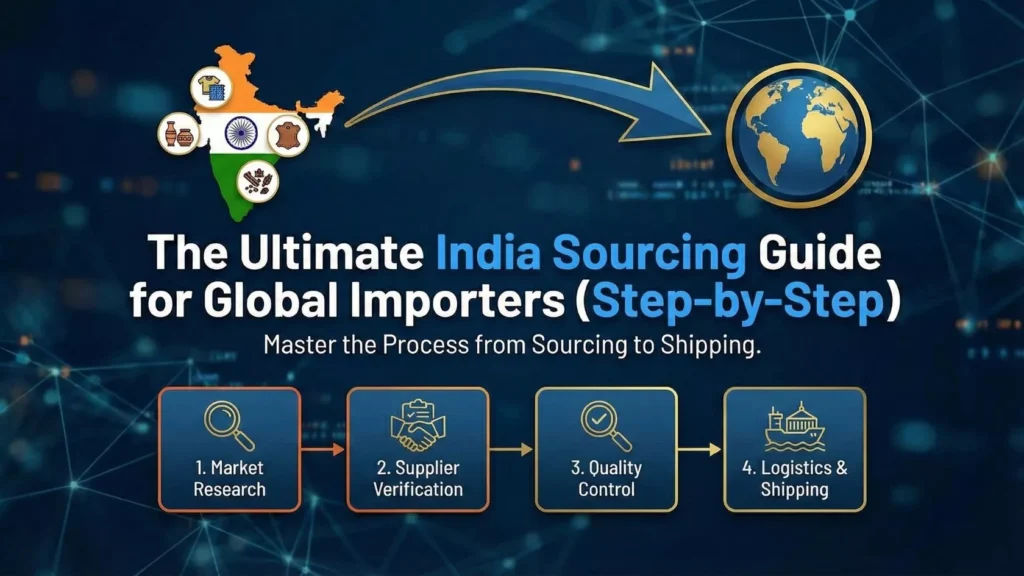
The Ultimate India Sourcing Guide for Global Importers (Step-by-Step)
India has become one of the most important sourcing destinations for global importers across the USA, EU, UK and Canada. From large-scale manufacturing and handicrafts to apparel, leather and home décor, the country offers a strong combination of production scale, cost efficiency and supplier diversity. As global supply chains continue to shift, many international buyers now consider India a long-term sourcing destination rather than a short-term alternative.
However, sourcing successfully from India requires far more than identifying factories online or requesting quotations through email. The supplier ecosystem is complex, regionally fragmented and varies widely in terms of capability, consistency and compliance maturity. This is why experienced buyers rely on a structured India Sourcing Guide to understand how sourcing functions in real operational environments.
This guide is written from a buyer’s perspective. It explains the sourcing process step by step, highlights the decisions that matter most and shows how professional partners like Panoramic Sourcing help importers build predictable and scalable sourcing operations in India.
Why Global Importers Need a Structured Sourcing Approach
India’s supplier base is vast, fragmented and highly specialized by region. Different sourcing hubs focus on different product categories, production techniques and order volumes. Without a clearly defined sourcing structure, importers often struggle to evaluate supplier capability, operational stability and long-term reliability.
A well-defined India Sourcing Guide breaks sourcing into logical stages and introduces control at every step. Instead of reacting to problems after they arise, buyers follow a proactive approach that anticipates risks and manages them early in the process.
Global buyers follow a structured sourcing approach to:
- Understand how Indian suppliers operate in practice
- Identify the right sourcing regions for specific product categories
- Set clear expectations for quality, compliance and documentation
- Control production timelines and landed costs
- Reduce operational, financial and reputational sourcing risks
For both first-time importers and experienced buyers, a structured framework replaces guesswork with clarity, accountability and repeatable outcomes.
Step-by-Step India Sourcing Process for Global Importers
The following steps outline how global importers can source from India systematically, reduce risk and build reliable long-term supply chains.
Step 1 — Supplier Discovery and Market Familiarization
The first stage in any sourcing journey is supplier discovery. India has thousands of factories and workshops across multiple industries, but not all are suitable for export business or aligned with international buyer requirements.
Supplier discovery involves understanding regional production strengths, identifying relevant manufacturing clusters and shortlisting suppliers based on product type, volume capacity and export experience. Early communication during this phase also helps buyers evaluate responsiveness, technical understanding and professionalism.
A practical India Sourcing Guide emphasizes that discovery is about identifying reliable long-term partners, not simply selecting the lowest-cost supplier.
Step 2 — Supplier Verification Before Any Commitment
Supplier verification is one of the most critical stages of sourcing and is often underestimated by importers. Verification ensures that supplier claims align with actual production capability rather than marketing promises or online profiles.
This stage typically includes reviewing production infrastructure, assessing workforce capacity, evaluating quality management practices and confirming compliance readiness. Buyers who skip verification frequently encounter delays, quality failures or regulatory issues after orders are placed.
A strong India Sourcing Guide treats supplier verification as a non-negotiable step before any commercial commitment is made.
Step 3 — Product Development and Sampling Discipline
Sampling bridges the gap between product concept and bulk execution. A reliable India Sourcing Guide treats sampling as a structured and documented process rather than a one-time formality.
During this phase, materials are finalized, construction methods are tested, finishes are approved and revisions are carefully documented. Sampling also allows buyers to validate cost assumptions, feasibility and production consistency before committing to large volumes.
Clear sampling discipline ensures products are production-ready, scalable and aligned with buyer expectations.
Step 4 — Pricing Transparency and Cost Control
Pricing in India can vary significantly depending on material quality, production method, labor structure and order volume. A trustworthy India Sourcing Guide stresses the importance of transparent and well-documented pricing from the outset.
Buyers should expect clarity on material costs, labor components, overheads and minimum order quantities. Transparent pricing prevents hidden charges and supports informed long-term sourcing decisions.
This stage also involves negotiation strategies that balance buyer margins with supplier sustainability, ensuring stable relationships across repeat orders.
Step 5 — Production Planning and Execution Oversight
Production is where most sourcing risks surface. Delays, quality deviations and communication gaps typically occur when oversight is weak or inconsistent.
Effective production management includes detailed timeline planning, regular factory follow-ups and early issue resolution during manufacturing. Buyers must also ensure production schedules align with shipping timelines and inventory planning in destination markets.
A structured India Sourcing Guide treats production oversight as an essential control point rather than a reactive task after problems emerge.
Step 6 — Quality Control as a Continuous Process
Quality control is not limited to final inspection alone. For global importers, quality must be monitored throughout the production cycle to ensure consistency across batches and repeat orders.
Inspections typically include in-process checks, final inspection before dispatch and packaging and labelling verification. This layered approach helps detect issues early and reduces rejection risk at destination markets.
A comprehensive India Sourcing Guide positions quality control as an ongoing activity rather than a single checkpoint.
Step 7 — Export Documentation and Logistics Readiness
Even when production and quality are managed well, documentation errors can delay shipments and increase landed costs. Export readiness is the final critical stage of sourcing.
This stage involves preparing accurate export documents, ensuring packaging compliance and coordinating with logistics partners. Clear documentation and timely coordination support smooth customs clearance and predictable delivery schedules.
Professional sourcing partners help buyers navigate this stage efficiently and reduce last-minute disruptions.
India’s Strategic Importance in Global Sourcing
India’s sourcing strength comes from its manufacturing depth, skilled workforce and export-oriented production across multiple sectors. The country supports both small workshops and large factories, allowing buyers to scale sourcing programs gradually.
According to the India Brand Equity Foundation (IBEF), manufacturing and exports remain key contributors to India’s global trade presence, with strong demand from North America and Europe.
Verified external source: https://www.ibef.org/industry/manufacturing
This export readiness reinforces the value of following a structured India Sourcing Guide when sourcing from India at scale.
How Panoramic Sourcing Supports Importers
Panoramic Sourcing operates as a dedicated, on-ground sourcing partner for global importers, providing structured oversight across the entire sourcing lifecycle. Its approach aligns supplier capability, production execution and quality assurance with buyer-defined commercial and compliance requirements.
Support spans supplier identification and verification, sampling coordination, transparent pricing and negotiation support, production monitoring, quality inspections and export readiness management. This end-to-end involvement ensures consistency, accountability and predictable outcomes for international buyers.
For importers seeking a standardized and repeatable framework, Panoramic Sourcing also provides a professionally documented India Sourcing Guide, available for download on its homepage, to help procurement teams standardize sourcing decisions across product categories.
Common Mistakes Importers Make Without a Guide
Importers sourcing from India without a structured India Sourcing Guide often face supplier misrepresentation, quality inconsistencies, missed timelines and unexpected cost escalations. These issues usually arise from relying on online listings and managing suppliers remotely without verification or production oversight.
Working with an experienced on-ground partner such as Panoramic Sourcing helps importers avoid these risks by applying a step-by-step sourcing framework, continuous monitoring and clear accountability throughout the sourcing process.
Conclusion
For importers in the USA, EU, UK and Canada, following a structured India Sourcing Guide is essential for sourcing success. India offers significant opportunities, but only when sourcing is managed methodically.
With professional support from Panoramic Sourcing, buyers gain clarity, control and confidence at every stage of the sourcing process. A well-executed sourcing framework transforms sourcing from India into a predictable, scalable and long-term operation.
FAQs
What is an India Sourcing Guide?
It explains the step-by-step process of sourcing products from India for global buyers.
Who should use this guide?
Importers, retailers and brands sourcing from India for the first time or at scale.
Does the guide include quality control?
Yes, it covers inspections, quality checks and compliance considerations.
Can small importers follow this process?
Yes, the framework applies to both small and large importers.
How does Panoramic Sourcing help buyers?
Panoramic Sourcing manages suppliers, production, quality and export coordination for international buyers.