
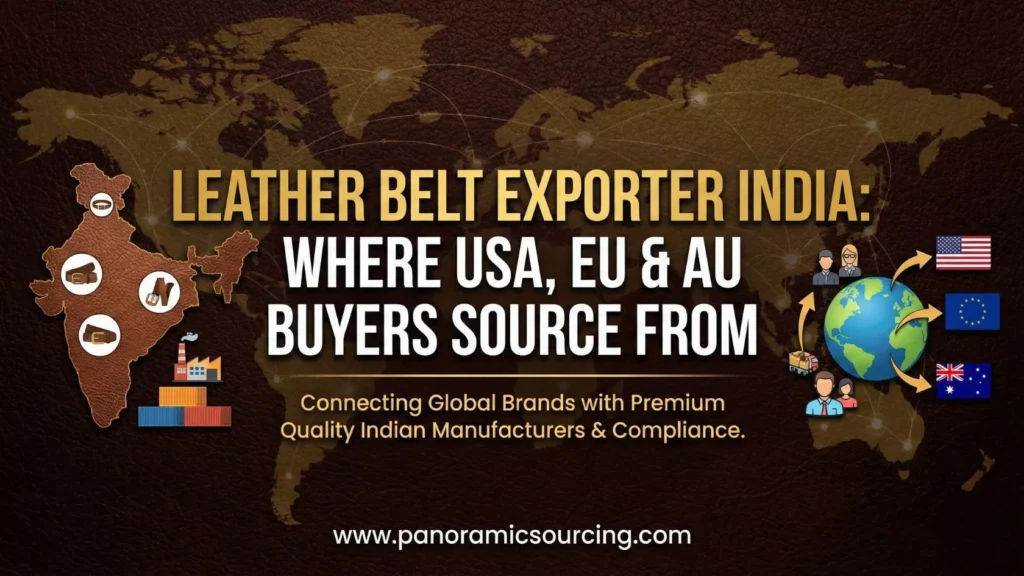
Leather Belt Exporter India: Where USA, EU & AU Buyers Source From
USA, EU, and Australian buyers importing leather belts from India typically evaluate suppliers on three non-negotiable factors: consistent leather quality, repeatable sizing and finishing and export documentation that clears customs without delays. India remains a preferred sourcing destination because it combines established tanning capacity, skilled accessory manufacturing clusters and a structured leather export ecosystem.
However, behind the search intent to “import leather belts” lies a more complex challenge. Buyers must identify a Leather belt exporter India partner who can prove material authenticity, meet destination-specific compliance requirements and still deliver on cost and timelines. This guide explains how international buyers evaluate suppliers—by manufacturing hubs, leather types, compliance readiness and verification methods—without relying on unreliable “top exporter” lists.
What “Export-Ready” Means When Importing Leather Belts
When shortlisting a Leather belt exporter India, experienced buyers prioritize operational capability over marketing claims. An export-ready supplier should demonstrate:
Export legitimacy: Valid IEC and GST registration, shipment history and documentation capability
Material traceability: Clear declaration of leather type, tannery source and test reports when required
Production control: Consistent strap cutting, edge finishing, hole spacing, buckle sourcing and packaging
Compliance awareness: Understanding of market-specific regulations, including EU expectations for chromium VI in leather articles that contact skin
This is where many belt suppliers fail. They can produce samples, but they struggle to repeat bulk quality or support compliance documentation for USA, EU and AU retail programs.
Exporter–Manufacturer Profiles Buyers Commonly Work With
Instead of chasing “top exporters,” most importers partner with one of the following supplier profiles.
Integrated Belt Manufacturers
These factories cut leather straps in-house, run finishing lines, assemble buckles and pack products for export. They are often the safest Leather belt exporter India option for private-label programs because they control variability in leather thickness, skiving, stitching and edge treatment.
Leather Goods Factories With Dedicated Belt Lines
Many leather goods manufacturers producing wallets or small leather accessories also operate belt lines. This model works well for buyers seeking coordinated collections such as belt-and-wallet sets with uniform branding.
Merchant Exporters With Audited Vendor Networks
Merchant exporters manage production across multiple factories. While this offers product variety, buyers must insist on factory-level transparency, defined QC checkpoints and pre-shipment inspections.
If minimizing surprises is the goal, choose a Leather belt exporter India supplier who can demonstrate process controls rather than simply offering the lowest unit price.
Where Export-Grade Leather Belts Are Manufactured in India
India’s leather belt production is concentrated in a few established clusters with long export histories.
Tamil Nadu Leather Corridor (Chennai–Ambur–Ranipet–Vaniyambadi)
This region is known for strong access to tanneries, compliance-ready factories and export-experienced production units. It is often preferred for large-volume programs and consistent finishing standards.
Uttar Pradesh (Kanpur–Agra)
Kanpur has a strong association with leather accessories, while Agra offers broad manufacturing capability. This region is cost-competitive but benefits from tighter buyer-side quality oversight.
West Bengal (Kolkata Leather Ecosystem)
This cluster is useful when belts are sourced alongside wallets or accessories as part of a broader assortment.
An experienced Leather belt exporter India typically operates within one or more of these clusters.
What “100% Genuine Leather” Should Mean for Belts
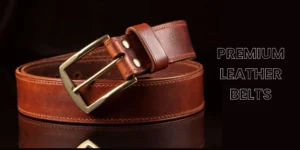
The term “genuine leather” is frequently misused. For import programs, buyers should define leather by hide type, cut, finish and tanning method.
Common Hide Types Used
Bovine (cow) leather – popular for dress and casual belts
Buffalo leather – chosen for heavier, textured belts
Goat leather – lighter weight, often used for fashion styles
Leather Cuts and Finishes
Full-grain – strongest surface, premium positioning
Top-grain – lightly corrected, uniform appearance
Corrected or pigmented grain – consistency-focused retail programs
Nubuck or suede – fashion belts requiring protective packaging
Tanning Methods and Compliance
Vegetable-tanned leather is preferred for heritage styling, while chrome-tanned leather offers color stability and softness. Buyers shipping to the EU should verify compliance with chromium VI requirements.
When evaluating a Leather belt exporter India, buyers should request leather specifications covering hide type, grain, thickness, finish, tannery source and available test reports.
Genuine Leather vs Faux Leather: Importer Comparison Table
| Evaluation Factor | Genuine Leather (Natural Leather) | Faux Leather (PU / PVC) |
|---|---|---|
| Material Source | Animal hide (bovine, buffalo, goat) | Synthetic polymers (PU or PVC) |
| Durability & Lifespan | High durability with natural aging and patina over time | Lower durability; prone to cracking or peeling with wear |
| Tear Resistance | Strong tear resistance, suitable for belt stress points | Weaker at stress areas such as holes and buckle folds |
| Visual Consistency | Natural grain variation between hides | Highly uniform appearance across batches |
| Premium Perception | Strong premium and heritage positioning | Budget or value-market positioning |
| Quality Control Needs | Requires tighter QC due to natural variation | Easier QC due to material uniformity |
| Compliance & Labeling | Requires clear leather declarations and testing where applicable | Requires accurate PU/PVC labeling to avoid misrepresentation |
| Return & Complaint Risk | Lower long-term return rates when quality is controlled | Higher risk of returns due to surface wear over time |
| Cost Structure | Higher raw material cost | Lower and more predictable material cost |
| Best Use Case | Mid-to-premium retail, long-term wear programs | Mass retail, promotional or price-sensitive programs |
Buyer Takeaway
If your buyer brief focuses on mass retail or promotional programs, faux leather belts can be suitable when PU or PVC composition is clearly specified and performance expectations are aligned. However, for lower return rates, longer product life and stronger perceived value, genuine leather belts remain the preferred choice for most USA, EU and AU retail programs.
How USA, EU & AU Buyers Typically Source Within India
Buyers rarely “import from a city.” They import through supplier networks.
Export Council Ecosystem
India’s leather export industry is supported by a national trade body that facilitates exporter participation, buyer introductions and compliance awareness.
Leather-Specific Trade Fairs
Events such as the India International Leather Fair allow buyers to evaluate multiple Leather belt exporter India options efficiently.
Sustainability and Traceability Directories
Many USA, EU and AU retailers use third-party platforms to support tannery and environmental verification as part of due diligence. One widely accepted reference is the Leather Working Group (LWG), which maintains a global directory of certified leather manufacturers and tanneries used by international buyers during supplier evaluation.
Destination-Specific Expectations
A Leather belt exporter India serving USA, EU and AU buyers must adapt to different market requirements.
USA: Labeling accuracy, e-commerce packaging and chemical compliance
European Union: Higher scrutiny on restricted substances and traceability
Australia: Emphasis on documentation quality and delivery reliability
Suppliers should confidently handle HS codes, packing lists, country-of-origin labeling and market-specific compliance.
How to Verify a Leather Belt Exporter Before Bulk Orders
Before placing bulk orders with a Leather belt exporter India, buyers should follow a structured verification process.
Documentation – IEC, GST, export invoices, buyer references
Material proof – Leather specs, tannery details, test reports
Sampling discipline – Pre-production, size set, sealed reference samples
Factory capability – Cutting accuracy, stitching, buckle plating
QC framework – AQL levels, tolerances, stress testing
Packaging & logistics – Anti-mold protection, export cartons
This process reduces disputes far more effectively than relying on rankings.
Panoramic Sourcing as an On-Ground Partner
For buyers who prefer structured support, Panoramic Sourcing works as an on-ground partner for identifying and managing Leather belt exporter India suppliers. The company assists with supplier verification, sampling coordination, production monitoring and export documentation alignment for USA, EU and AU markets.
This approach is especially useful for private-label programs where leather authenticity, QC consistency and compliance transparency are critical.
Conclusion
For USA, EU and AU retail programs, the right Leather belt exporter India partner is defined by operational proof—not marketing claims. Buyers should prioritize suppliers who deliver consistent bulk quality, clearly document leather specifications and demonstrate export readiness. By sourcing from established hubs, using verified discovery channels and locking QC frameworks before bulk production, importers can significantly reduce risk and build long-term supply stability.
FAQs
1. Why is India a major sourcing base for leather belts?
India offers tanning capacity, skilled labor and export infrastructure suited to global retail requirements, making it attractive for buyers seeking a reliable Leather belt exporter India partner.
2. What leather types are most commonly used?
Bovine and buffalo leather dominate exports, with goat leather used for lighter fashion belts.
3. How can buyers verify genuine leather claims?
By reviewing leather specifications, tannery details, and test reports provided by the Leather belt exporter India supplier.
4. Are Indian suppliers compliant with EU regulations?
Many export-ready suppliers understand EU requirements, but buyers must verify documentation early.
5. Should buyers work directly with factories or through sourcing partners?
Both models work. On-ground partners can help manage risk when dealing with multiple Leather belt exporter India suppliers.