
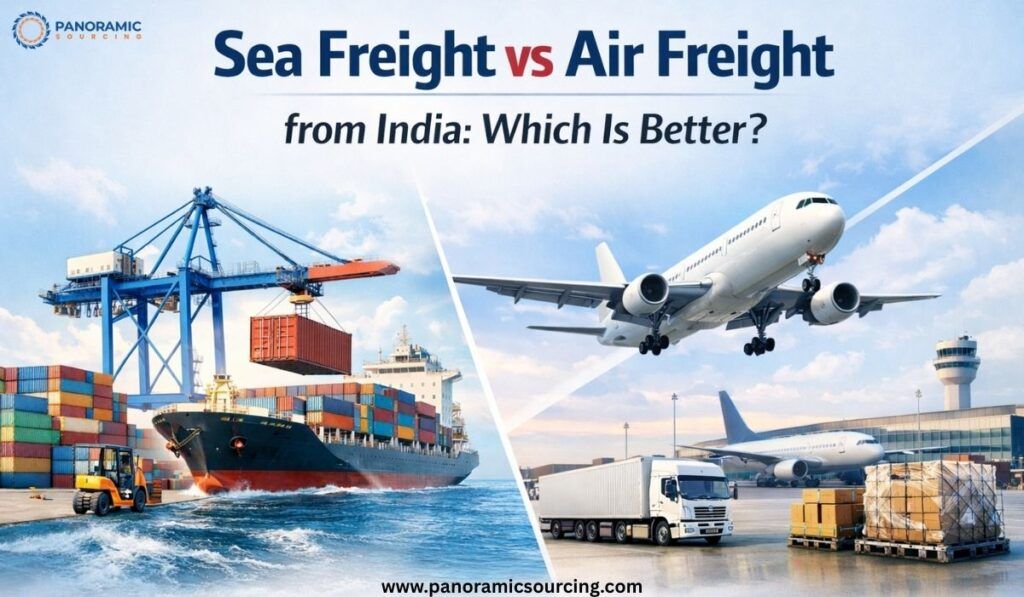
Sea Freight vs Air Freight from India: Which Is Better?
One of the most important business decisions an importer has to make is how to transport his/her goods between the manufacturing centers of India and the global market. Whether to use Sea Freight vs Air Freight from India has a direct bearing on the cost of landing, your inventory turnover and eventually your customer satisfaction.
India has long coastline and the international airports are well modernized providing powerful alternatives to both. The best selection is however never a long lasting one; it changes depending on the type of your products, the present global fuel surcharge and the urgency of your supply chain. As a brand that has a source of handicrafts, textile, or leather products, the explanation of trade-offs between Sea Freight vs Air Freight from India is critical to be able to preserve the competitive advantage in 2026.
Sea Freight vs Air Freight from India: A Detailed Comparison
In order to make a wise decision, importers should consider or analyze some of the key performance indicators (KPIs) such as cost, speed and shipment size. The following is the comparison of the two modes.
1. Cost Efficiency and Weight Brackets
The cost is typically the key motivation of most businesses. As a rule, sea transportation costs much less when large and heavy packages are involved. Nevertheless, when the shipment involves small shipments (as a rule, below 100kg), the minimum charges related to sea freight (such as terminal handling and documentation) can render air freight less expensive.
In estimating the cost of the Sea Freight vs Air Freight from India, one should always consider the chargeable weight (volumetric weight), not just the gross weight.
2. Speed and Transit Times
The difference between the time to market is enormous and can be a make-or-buy difference in the seasonal goods.
- Air Freight:
Air freight takes 3–7 days between such large centers as Delhi (DEL) or Mumbai (BOM) and Europe or the USA. According to the International Air Transport Association (IATA), air cargo plays a crucial role in global supply chains and high-value shipments. - Sea Freight:
Takes a period of between 25 and 45 days, again depending on the shipping location of Mundra, Nhava Sheva or Chennai.
3. Shipment Size and Volume
The technical gatekeeper is shipment size. Air freight cannot be done at all in case of transporting 100 cubic meters of home decor. When it comes to the high-end jewelry of 50kg mass, sea freight is a waste.
- Sea Freight:
This is suitable where the shipment of bulky goods is in FCL (Full Container Load) or LCL (Less than Container Load). - Air Freight:
This is ideal in case of small packages, samples and low-volume, high-value inventory.
Critical Factors in Choosing the Right Logistics Option
These three stages of the logistics strategy should be weighed when comparing Sea Freight vs Air Freight from India:
A. Product Value-to-Weight Ratio
High value and low-weight products (such as jewelry or high-quality electronics) are nearly always more appropriate to air freight. Shipment cost is a minute percentage of the retail price of the product.
On the other hand, large products such as furniture or heavy-stone handicrafts are not allowed in the air and have to be shipped by sea in order to be profitable.
B. Inventory Lead Times and Seasonality
Air freight enables you to make smaller, more regular shipments to keep your brand fresh in case your business works on a fast-fashion basis and drops new collections regularly.
With a consistent, large product line with predictable demand and a stable high-volume product line, then the long sea freight lead times can be dealt with through an appropriate plan.
C. Safety, Frailty and Moving
Air freight is less handled and with less transit time which tends to be more safe when dealing with the fragile even high sensitivity items.
Although sea freight involves the use of robust containers, the last mile and loading points in more than one location pose a risk of having minor cosmetic damages or getting exposed to moisture unless packed properly to withstand the long ocean journey.
Why Choose Panoramic Sourcing for Your Logistics Strategy?
We do not simply identify suppliers at Panoramic sourcing but we handle all the transportation of products between the center part of India and your doors. We know that the logistics between Sea Freight vs Air Freight from India may be too intense to handle as an international buyer.
Strategic Logistics Planning
We are your boots on the ground to make sure that your logistics strategy is optimized to your particular business model.
In the case with Panoramic Sourcing, we offer:
- Consolidation Services:
Our shop will be able to lump together the orders of various Indian craftsmen into one LCL (Less than Container Load) so that you will save a lot of money on shipping charges. - Real-time Freight Audits:
We benchmark the existing sea freight vs air freight from India on various airlines to make sure you are not overcharged in high season times. - Customs Expertise:
Our staff makes sure that all the paperwork, including the Bill of Lading, Airway Bills and Certificates of Origin, is impeccable so that costly port storage charges and customs delays will be eliminated.
At Panoramic Sourcing, we aim to deliver your goods to your location with minimal or no damage, on-time and at the lowest landed cost since it will not matter the shipping mode that you decide to use.
Deep Dive: The “Middle Ground” and Hybrid Options
In 2026, importers increasingly use hybrid logistics solutions between sea freight vs air freight from India. Sea-Air shipping combines sea transport to hubs like Dubai with air delivery for balanced cost and speed. LCL shipments allow smaller sea freight loads, while express couriers like DHL or FedEx handle urgent samples and small packages efficiently.
Conclusion
There is no universal solution to the discussion of Sea Freight vs Air Freight from India. It depends upon your business needs: is it a tailored business need to go with the speed and high-value security, or is it a cost-sensitive growth to go with the volume and sea.
You can rely on an expert to lead you through such complicated decisions by collaborating with a committed partner such as Panoramic Sourcing. We make sure that you have a robust supply chain capable of swinging in both directions whenever market conditions or shipping rates fluctuate so that your Indian sourcing experience is profitable and predictable.
FAQs
- In what cases does Sea Freight vs Air Freight from India cost more?
As a rule, sea freight wins over 500kg or more than 2 cubic meters of shipment. Airfreight/courier is commonly cheap in case of shipments less than 100kg because of the reduced fixed port charges. - What is the duration of Sea Freight vs Air Freight from India?
Between big ports, such as Nhava Sheva (Mumbai) and the US East Coast, the transit time is usually 28–35 days; the West Coast is 35–45 days. - Does Panoramic Sourcing assist door-to-door shipping?
Yes, we take care of the whole process together with the factory gate in India to your warehouse taking care of the Sea Freight vs Air Freight from India choice as well as the trucking locally. - What are the primary risks of airfreight?
Increased costs and more stringent rules about the so-called dangerous goods (such as batteries or some liquids) are the major threats since the shipment may be rejected in case of failure to declare them properly. - Is sea freight better packaged than air?
Yes, since sea freight is more susceptible to humidity and subject to more physical handling during ports systems, it is strongly suggested to use double-walled box and silica gel that keeps moisture away.