
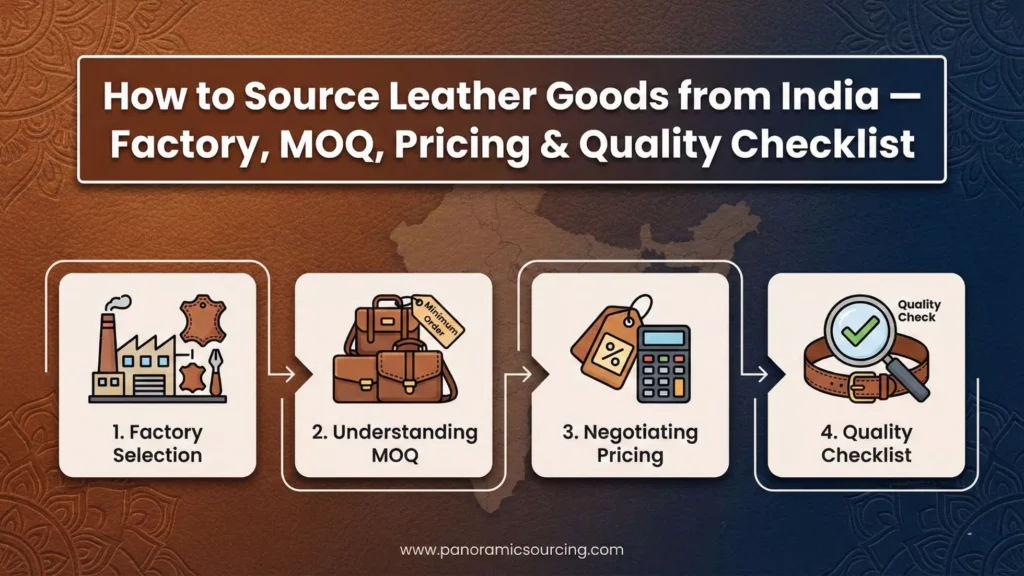
How to Source Leather Goods from India — Factory, MOQ, Pricing & Quality Checklist
The global leather industry is undergoing a period of realignment. For private label brands and importers in the USA and UK, understanding how to source leather goods from India has shifted from being a cost-driven exercise to a strategic sourcing capability. India is now the world’s second-largest producer of leather footwear and garments, supported by a vertically integrated supply chain that spans raw hides, tanning, finishing and export-ready manufacturing.
For international buyers, India’s leather sector offers scale, craftsmanship, and flexibility. However, it is also highly regionalized and technically complex. Successfully learning how to source leather goods from India requires a structured approach built around four pillars: selecting the right factory cluster, managing MOQs, understanding export pricing and enforcing rigorous quality control. This article explains the sourcing workflow step by step, specifically for buyers serving retail and e-commerce markets in the USA and UK.
Understanding India’s Leather Manufacturing Landscape
Before engaging suppliers, buyers must understand that Indian leather manufacturing is not centralized. Production is organized into specialized clusters, each with distinct strengths in materials, finishing and product categories. Knowing how to source leather goods from India starts with choosing the right geography, as this decision directly affects cost structure, quality consistency and delivery reliability.
India’s leather ecosystem benefits from domestic availability of bovine, goat and sheepskin hides, along with long-established tanning expertise. These factors allow manufacturers to offer competitive pricing while maintaining export-grade quality standards for Western markets.
How to Select the Right Factory: India’s Leather Clusters
Southern India: Chennai, Ambur, and the Palar Valley
Tamil Nadu accounts for nearly half of India’s tanning capacity. The Chennai–Ambur–Ranipet belt is the preferred destination for premium footwear, leather garments and structured bags. Factories here are highly export-oriented and experienced with environmental compliance, making this region ideal for buyers who prioritize sustainability certifications and consistent finishing.
For brands in the USA and UK producing footwear or higher-value leather apparel, this region represents the most reliable entry point when evaluating how to source leather goods from India.
Northern India: Kanpur and Agra
Kanpur is internationally recognized for buffalo leather processing and is well suited for belts, wallets, saddlery and industrial leather products. Agra, located nearby, is a major footwear manufacturing center with strong capabilities in mid- to high-volume production. Buyers targeting durability-focused leather goods often source from this region.
Eastern India: Kolkata and Bantala
Kolkata’s Bantala Leather Complex is a consolidated manufacturing estate known for small leather goods such as wallets, clutches, and handbags. The region combines skilled hand-finishing with modern export infrastructure, making it particularly attractive for boutique and mid-sized brands in the UK.
For verified manufacturer data and export guidance, buyers can refer to the Council for Leather Exports, which serves as the official industry body supporting Indian leather exporters.
How to Manage MOQs: Balancing Scale and Flexibility
A key advantage of Indian sourcing is flexibility in order quantities. Understanding how to source leather goods from India means knowing how to align MOQs with your brand’s growth stage.
Typical MOQ Benchmarks
Small leather goods (wallets, belts): 100–200 units per style
Handbags and backpacks: 50–100 units per style
Footwear: 200–500 pairs per style
These thresholds are generally lower than many competing sourcing countries, making India suitable for private labels and test launches.
Negotiating Smaller Runs
Many factories are open to trial orders, particularly for handcrafted or design-led products. When buyers clearly communicate long-term volume potential, suppliers are often willing to accommodate reduced MOQs. This flexibility is a defining factor in how to source leather goods from India without locking capital into excessive inventory.
How to Understand Pricing: Export Cost Structures Explained
Pricing transparency is critical for accurate landed cost calculation. A major component of how to source leather goods from India is understanding FOB-based pricing and the variables that influence it.
Key Cost Drivers
Leather type: Cow, buffalo, goat or sheep
Tanning method: Vegetable-tanned leather costs more than chrome-tanned alternatives
Hide grade: Full-grain and top-grain command premium pricing
Hardware and linings: Zippers, buckles and inner materials affect unit cost
Indicative FOB Price Ranges
Leather wallets: USD 5–12
Leather handbags: USD 30–90
India’s cost competitiveness is supported by localized access to raw hides and tanning infrastructure, allowing exporters to maintain stable pricing for USA and UK buyers even during global supply fluctuations.
How to Enforce Quality: A 20-Point Leather Inspection Checklist
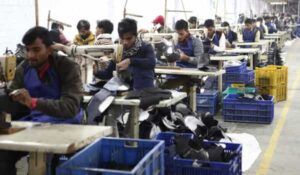
Quality control is non-negotiable. Any discussion on how to source leather goods from India must include a structured inspection framework to protect brand reputation, meet USA and UK retail standards and reduce post-delivery claims.
Buyers sourcing leather goods for the USA and UK often align their inspection processes with internationally recognized leather quality and compliance benchmarks published by the Council for Leather Exports (CLE), India’s official leather export authority.
Material and Construction Checks
1. Odor Inspection
Checks for chemical, ammonia, or mildew smells that indicate improper tanning or storage.
2. Grain Consistency
Verifies uniform leather grain and texture across all panels of the product.
3. Color Fastness (Wet & Dry Rub)
Tests dye stability to ensure color does not bleed or transfer during use.
4. Leather Thickness Verification
Measures thickness using calipers to confirm compliance with the specified 1.2–2.0 mm range.
5. Stitch Density and Alignment
Checks stitch consistency and straightness to prevent seam failure during use.
6. Edge Painting Quality
Ensures edges are smooth, evenly coated and free from cracks or tackiness.
7. Lining Attachment and Finish
Confirms lining is securely attached, straight and free from loose threads.
Hardware and Functional Testing
8. Zipper Cycle Testing
Opens and closes each zipper a minimum of 20 times to confirm smooth operation.
9. Metal Detection Scan
Identifies broken needles or metallic fragments to meet export safety standards.
10. Load Testing of Handles and Straps
Applies weight stress to validate handle and strap strength.
11. Hardware Finish Inspection
Checks buckles, rings, and fittings for rust, scratches or coating defects.
12. Magnet and Clasp Strength Test
Ensures closures engage securely without being too weak or overly rigid.
13. Strap Adjustability Check
Verifies sliders and buckles move freely and lock securely at all settings.
Dimensions, Compliance and Packaging
14. Measurement Accuracy
Confirms finished goods match approved dimensions listed in the tech pack.
15. Mandatory Labeling Verification
Ensures “Made in India” and material composition labels are correctly applied.
16. Mold Prevention Measures
Checks for silica gel and anti-mold stickers inside each unit.
17. Export Carton Strength
Validates the use of 7-ply corrugated cartons suitable for international shipping.
18. Barcode Scannability
Tests retail barcodes to ensure accurate scanning at warehouse and POS levels.
19. Seam Pull Resistance
Applies force to seams to ensure they do not gape or expose needle holes.
20. Finish Adhesion Test
Uses standardized tape testing to confirm the leather finish does not peel.
Implementing this 20-point checklist at multiple stages of production ensures consistent outcomes when executing how to source leather goods from India for USA and UK retail markets.
Managing the Workflow with On-Ground Support
For overseas buyers, coordinating factories, inspections and timelines remotely can be challenging. This is where professional sourcing support becomes valuable.
The Role of Panoramic Sourcing
Panoramic Sourcing operates as a buying office for international brands sourcing leather goods from India. The firm maintains vetted factory networks across Chennai, Kanpur, and Kolkata and conducts supplier due diligence, including certification verification such as LWG, SEDEX and BSCI.
Their on-ground teams manage in-line inspections using the 20-point checklist, ensuring issues are corrected before packing. This hands-on execution simplifies how to source leather goods from India for buyers who require consistent quality without maintaining local teams.
Compliance and Export Readiness for USA & UK Markets
Leather imports into the USA and UK are subject to labeling, material disclosure and chemical safety regulations. Understanding how to source leather goods from India includes verifying compliance with destination-market requirements, including restricted substance controls and accurate HS code classification.
Indian exporters experienced in Western markets are generally familiar with these standards, but buyers should ensure compliance is validated before shipment to avoid delays or penalties at customs.
Conclusion
Successfully mastering how to source leather goods from India requires more than identifying factories. It demands geographic knowledge, MOQ strategy, cost transparency and uncompromising quality control. By sourcing from the right clusters, leveraging India’s flexibility and enforcing a structured inspection process, brands in the USA and UK can build reliable and scalable leather supply chains.
Whether managed independently or through a sourcing partner, India’s depth in leather craftsmanship and export capability provides a strong foundation for long-term private label success.
FAQs
1. How do I find a reliable leather factory in India?
Focus on specialized clusters such as Chennai for footwear or Kolkata for bags and verify export experience and certifications.
2. What are standard MOQs for leather goods?
Typically 50–100 units for bags and 100–200 units for small leather accessories.
3. How is leather product pricing calculated?
Pricing depends on hide type, tanning method, leather grade and hardware quality.
4. How can I ensure consistent quality?
Use a multi-stage inspection process supported by a detailed 20-point checklist.
5. Does Panoramic Sourcing support logistics and documentation?
Yes, including export documentation, HS classification and coordination with freight partners.