
India vs Bangladesh Garment Manufacturing: Key Differences
Understanding the Shift in India vs Bangladesh Garment Manufacturing
If you’ve been sourcing in South Asia lately, you know the landscape has shifted. We used to talk about India vs Bangladesh garment manufacturing as a simple choice between “cheap bulk” and “complex design.” But as we move through 2026, those lines are blurring.
The “China Plus One” strategy isn’t just a buzzword anymore—it’s a survival tactic. Brands are looking at these two neighbors and realizing the decision isn’t just about the lowest price per unit. It’s about who can actually get a container to the port on time when global supply chains get messy. While Bangladesh is still the heavyweight for sheer volume, India’s recent push into vertical integration is making a lot of procurement heads rethink their strategy regarding India vs Bangladesh garment manufacturing.
The Realities of India vs Bangladesh Garment Manufacturing in 2026
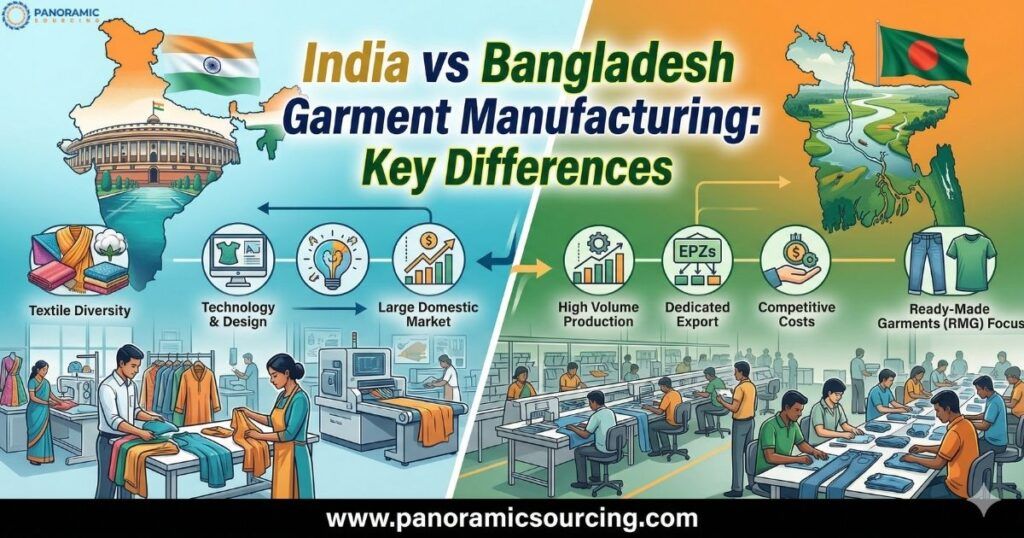
When you dig into the data behind India vs Bangladesh garment manufacturing, the differences come down to how each country handles its “back-end.” Bangladesh is built for the “Ready-Made Garment” (RMG) model—it’s their bread and butter. India, on the other hand, is a full-stack player. They grow the cotton, spin the yarn and stitch the shirt often within the same region.
1. The Pricing Gap is Closing
For a long time, Bangladesh was the undisputed king of low-cost labor. But 2026 has brought some new realities.
Bangladesh: After the wage reforms in late 2025, the minimum wage moved to roughly 15,500 BDT. It’s still very competitive, but the era of “ultra-cheap” manufacturing is fading.
India: While Indian wages stay slightly higher (usually between $150 and $180), the government’s PLI Scheme and better factory automation have boosted productivity. When you factor in the speed of production, the price difference isn’t as wide as it once was.
2. Raw Materials: The Lead Time Killer
This is where India vs Bangladesh garment manufacturing really diverges.
India’s Advantage: Since India is a massive producer of cotton and man-made fibers, factories don’t have to wait for fabric to clear customs. If you need a quick turnaround on a seasonal collection, sourcing locally in India saves weeks.
Bangladesh’s Dependency: Bangladesh still brings in about $16 billion in fabric and yarn from outside its borders. In a year like 2026, where shipping routes can be unpredictable, that dependency adds a layer of risk to your delivery dates.
3. Complexity vs. Scale
Choose your hub based on your tech pack.
Bangladesh: There is no better place on earth for 50,000 pairs of basic denim jeans. Their “Mega-Factories” are tuned for efficiency.
India: This is where you go for the “hard stuff.” Whether it’s intricate embroidery, organic blends, or the new wave of performance activewear, India’s workforce is better equipped for high-skill construction and smaller batches.
Comparison: India vs Bangladesh
| Key Metric | India | Bangladesh |
| Main Strength | Full supply chain & design variety | Massive scale & specialized efficiency |
| Material Source | Local (Cotton, Silk, Synthetics) | Mostly Imported |
| Minimum Orders | Very flexible (500 – 1,000 pcs) | High (5,000+ pcs typically) |
| Compliance | Strong focus on social audits | World leader in LEED-certified factories |
| 2026 Status | Fast-tracking trade deals (UK/EU) | Graduating from LDC status |
How Policy is Changing the Game in 2026
The competition in India vs Bangladesh garment manufacturing is being reshaped by major government moves that are forcing brands to rethink their long-term contracts.
The “Tariff Cliff” for Bangladesh: Since Bangladesh is officially moving out of the “Least Developed Country” (LDC) category this year, they are losing the automatic duty-free perks that made them so dominant. They’re working hard to secure GSP+ deals, but for a buyer, it’s a bit of a nail-biter. If those deals aren’t ironclad, you could see a sudden 10–12% jump in landed costs. This uncertainty is pushing many of our clients to diversify their production bases now, rather than waiting for a surprise tax bill at the port.
India’s Infrastructure Push: On the flip side, India is finally fixing the “last-mile” problems that used to drive sourcing managers crazy. The PM-MITRA textile parks are now fully operational “plug-and-play” zones. By clustering spinning, weaving and processing in one spot, they’ve slashed the massive logistics costs and transit delays that used to plague Indian exports. Combined with the PLI Scheme’s cash incentives for man-made fibers, India isn’t just a design hub anymore—it’s becoming a high-speed, cost-competitive machine that can actually challenge the scale of Dhaka’s biggest factories.
Source: Ministry of Textiles India
Panoramic Sourcing: Your Gateway to the Region
At Panoramic Sourcing, we don’t operate our own textile mills; instead, we act as your strategic boots-on-the-ground. We’ve spent years vetting a massive network of suppliers across both India and Bangladesh, ensuring you get the right factory for your specific product category without the usual trial-and-error. By bridging the gap between global brands and local manufacturers, we provide a transparent look at the pros and cons of India vs Bangladesh garment manufacturing so you can make data-driven sourcing decisions.
Navigating the Shift to India
We’re helping more brands move their “high-value” lines to India through our verified partner network. It’s not just about the embroidery anymore. With the rise of “Agile Retail,” you need to drop new styles every few weeks. Our connections in India specialize in handling lower MOQs and navigating the 18% tariff favor in the US market, making it a “safe bet” for your 2026 inventory.
Leveraging Bangladesh’s Massive Scale
Don’t count Bangladesh out—their resilience is legendary. Even with the political shifts of the last year, the factory owners we work with have doubled down on Green Manufacturing. They host the highest number of LEED-certified factories globally. If your brand’s main selling point is a low carbon footprint at a massive scale, we can connect you with the most compliant, high-capacity facilities in the region.
Conclusion
When you weigh up India vs Bangladesh garment manufacturing, the winner depends on your business model. If you’re a volume player where every cent counts, Bangladesh is your home. If you value speed, material variety and the ability to pivot styles quickly, India is likely the better partner. Most smart buyers are now splitting their risk—keeping core basics in Dhaka and fashion-forward pieces in Indian hubs like Tirupur or Noida.
FAQs
1. Who wins on shipping speed in India vs Bangladesh garment manufacturing?
India usually wins here because they have raw materials on hand, whereas Bangladesh often has to wait for fabric imports to arrive before they can start cutting.
2. Is Bangladesh still duty-free in 2026?
It’s a transition year. While many benefits remain under new GSP+ schemes, the “automatic” duty-free status is changing as they graduate from LDC status.
3. Which country is better for organic clothing as per India vs Bangladesh garment manufacturing?
India is a top producer of organic cotton, making it the easier choice for sustainable “fiber-to-shelf” sourcing through our local supplier network.
4. How do wages compare right now?
The gap is smaller than ever. India is still slightly more expensive, but Bangladesh’s recent wage hikes to 15,500 BDT have leveled the playing field significantly.
5. Can I get small orders done in Bangladesh?
It’s tough. Bangladesh is built for volume. For MOQs under 1,000 pieces, we typically recommend our Indian manufacturing partners.