
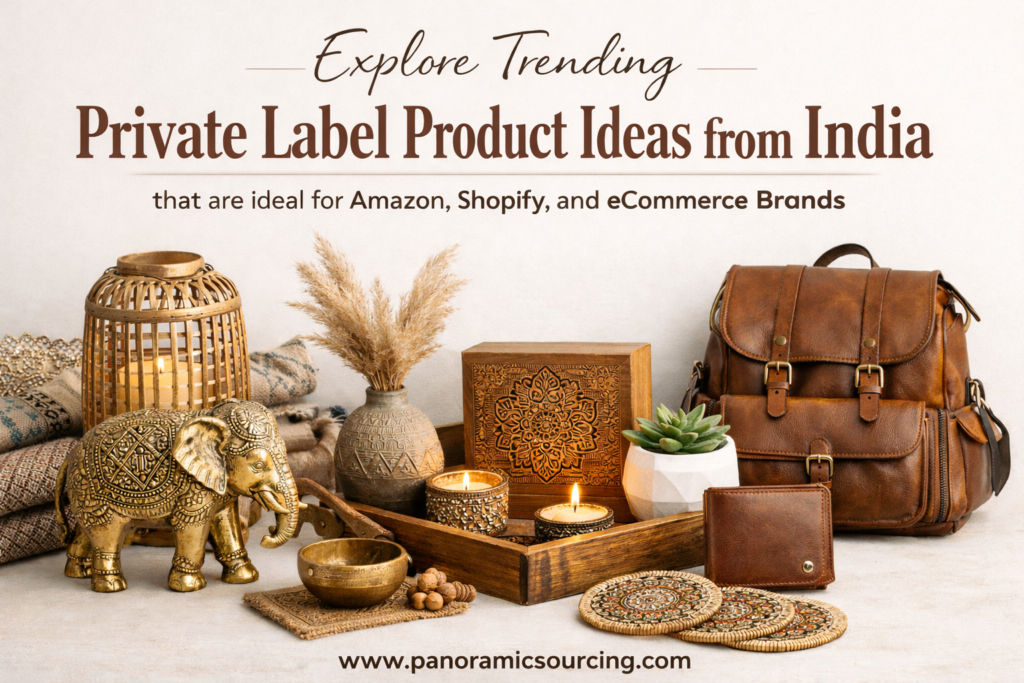
Top Private Label Product Ideas from India for Ecommerce Sellers
India has emerged as one of the most effective sourcing countries to ecommerce entrepreneurs who intend to create lucrative private label brands. The country has a great experience in manufacturing, competitive prices and the most impressive diversity of export industries, which provides the USA and international buyers with the best opportunity ever. In case you are in the hunt of scalable private label product ideas from India, you are accessing a sourcing system that Amazon sellers, Shopify brands and retail chains globally trust.
Indian manufacturers synthesize artisanship and industrial capacity and are therefore; both boutique label and high volume e-commerce friendly. In home decor and fashion accessories, the Private Label Product Ideas from India allows the brands to draw distinctions in their designs, packaging and narration.
Why Global Sellers are Attracted to Private Label Product Ideas from India
Ecommerce brands have a number of strategic rationale why they consider of having Private Label Product Ideas from India. First, India has got good export infrastructure and compliance standards that are in line with the US and EU regulations. Second, suppliers become more skilled in dealing with ecommerce companies, such as low MOQ and custom packaging.
Based on the observations of the export industry by India Brand Equity Foundation, India is further increasing its presence in the outbound shipments of consumer goods and in particular textile, handicraft and lifestyle goods.
The key benefits for brands considering Private Label Product Ideas from India:
- Costs of manufactures competitive.
- Professional artisan and industrial industries.
- Diverse capability of private labeling.
- Large availability of raw materials.
- Good international shipping systems.
All these advantages enable the ecommerce sellers to develop margin rich product lines without affecting quality.
Best-Selling Private Label Product Ideas from India in 2026
In examining the concept of the Private Label Product Ideas from India, it is beneficial to consider those categories that are in demand in the world and showing the repeat purchase pattern. The following are some of the best-performing product segments in all three Amazon, Shopify and DTC marketplaces.
Indian Home Decor Private label product concepts
Home decor is other export sectors that are still performing well. Indian producers have a reputation of finishes that are handcrafted, sustainable materials and distinct cultural styles which appeal to the international customers.
Popular options include:
- Ornamented trays and storage baskets.
- Cushion covers and textiles
- Wall paintings and custom-made mirrors.
- Brass and wooden accents
- Serge collections, tableware.
These products can be branded by packaging, storytelling and environmentally friendly positioning.
Fashion and Lifestyle Goods and Accessories in Private Label Product Ideas from India
Fashion accessories offer good branding possibilities and recurring demand seasonally. Lots of ecommerce sellers construct brand identities out of collections of accessories.
Top segments include:
- Handbags and fabric totes
- Textile accessories and scarlets.
- Ornaments on jewelry and fashion.
- Hair accessories
- Travel organizers
Individual brands that consider the prospect of adopting the private label product ideas from India tend to use the reputation of India as a source of textile, natural fibers and embroidering, which can be seen as an added value.
Leather Goods in Private Label Product Ideas from India
India is a leading exporter of finishes leather and leather accessories in the world making it a good place to start a brand to create the finest lifestyle brand. The leather products have good margins, extended product life cycles and are in demand in the western markets as ideas of sellers researching the possibilities of selling the products in India finding the ideas of the private label products.
The manufacturing clusters of Indian leather production involve both modern and hand-made finish to enable the brands to market the products as both luxurious and ethical in case they were procured in a responsible manner.
There are high performing leather categories:
- Crossbody bag and leather handbags.
- Purses and minor items.
- Passport holders and travel organizers.
- Fashion accessories and leather belts.
- Leather office and desk commodities.
- Laptop cases and business bags.
Vegetable-tanned leather and environmentally-friendly production, supported by many Indian factories, attracts the consumers that are driven by sustainability. The use of a private labeling ensures that the brands customize the finishes, colors, textures, embossing and packaging and produce a unique identity.
As an ecommerce seller targeting Amazon, Shopify and boutique retail, leather is one of the most scalable India-based product ideas in the form of a private label since it has the ability to be both durable and has a high-end brand potential.
Green and Environmental-friendly Products
Green product is one of the most rapidly developing types of ecommerce. India has a large potential in natural fiber and biodegradable resources; hence, it is a major powerhouse of sustainable production in the world.
Examples include:
- Shopping bags made of Jute and Cotton.
- Bamboo household goods
- Reusable kitchen textiles
- Lifestyle accessories that are organic.
- Storage products of natural fibers.
Sellers who have been concentrating on the idea of the private label products of India usually struggle to find that the sustainability positioning enables them to charge premium prices and achieve a greater brand loyalty in the mind of the conscious customers.
Panoramic Sourcing: Scalable Brands based on Private Label Product Ideas from India
Panoramic Sourcing helps USA and international customers to identify and deal with certified Indian manufacturers and to control the life cycle of production. Ecommerce brands receive institutional sourcing assistance instead of going it alone in dealing with supplier uncertainty.
Core services include:
- Verified supplier sourcing
- Product sampling and development.
- Personalized packaging and labelling.
- Quality inspections
- Export logistics organization.
For businesses pursuing Private Label Product Ideas from India, working with a professional sourcing partner reduces delays, protects quality standards and improves communication. Panoramic Sourcing enables brands to scale confidently with transparent manufacturing relationships.
Conclusion
India is the best place to consider when it comes to ecommerce brands intending on establishing scalable line of private labels. The expansive assortment of the idea of the private label product in India with its strong production capacity in the areas of decor, accessories, leather and eco-friendly products, the USA and the sellers around the globe will have no doubt about the advantage in terms of competition. The brands able to integrate intelligent choice of products with dependable sourcing alliances are the ones that can be able to expand steadily in foreign markets.
FAQs
1. What makes Indian-made, but labeled as a private label product profitable?
India has low cost of production, human resource and a wide range of product lines and therefore brands stand to make good profit whilst producing quality products.
2. What category should one begin with the private labelling?
Good entry products include home decor, textiles and environmentally friendly lifestyle products due to their combination of demand, differentiation and branding.
3. Is India a good place to start small ecommerce business?
Yes. Most of the Indian manufacturers enforce low MOQs and bespoke packaging, and they are suitable when a new product is being tested on a new brand.
4. What can I do to maintain product quality in sourcing India?
Cooperate with approved suppliers, order samples, inspect them, and work with an agency that handles the quality.
5. Are the Indian products in compliance with the US and EU regulations?
Exporters who are reputable are also able to meet international standards, although compliance checks need to be always verified prior to production.