
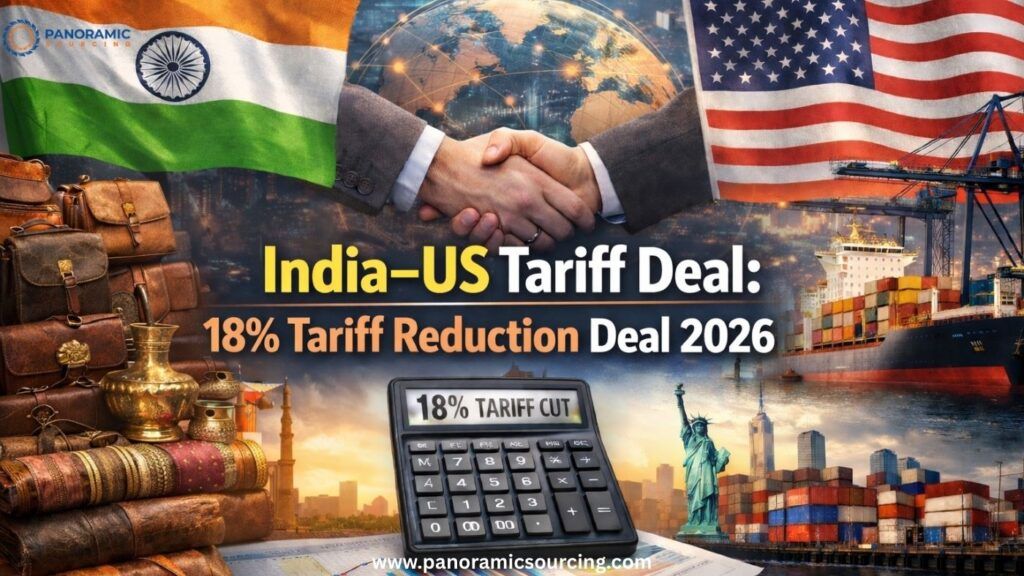
India-US Trade Deal 2026: Why the Tariff Reduction Makes India Your Top Sourcing Partner
The 2026 India–US Trade Announcement That Reshaped Import Economics
In early February 2026, the global sourcing landscape experienced a major positive shift. On February 2, 2026, following a phone call between US President Donald Trump and Indian Prime Minister Narendra Modi, the United States announced a new trade framework with India. This was confirmed via Trump’s Truth Social post, Modi’s response on X and widespread coverage in outlets like Reuters, CNBC, The Hindu, Times of India and others.
The core of the deal: the US immediately reduced its reciprocal Tariff on Indian goods from 25% to 18%. Critically, it also eliminated an additional 25% punitive Tariff previously applied due to India’s purchases of Russian oil. This combined reduction brought effective tariff exposure down from levels as high as 50% on many Indian exports to the more manageable 18% reciprocal rate (applied in addition to standard Most Favored Nation/base duties, which are often low or zero for labor-intensive products).
This change directly addresses months of trade tension and uncertainty. For US importers, it replaces volatility with far greater predictability, enabling confident long-term planning, stable pricing and margin protection. Both leaders framed the agreement as a win for bilateral ties—Trump highlighted “friendship and respect,” while Modi expressed delight that “Made in India products will now have a reduced tariff of 18%.”
For sourcing companies like Panoramic Sourcing and their partners, this strengthens India’s edge in key categories: leather goods, handicrafts, home furnishings and fashion accessories. These sectors already excel in craftsmanship, skilled labor, ethical production and scalable manufacturing. With lower duties, Indian suppliers become even more competitive against alternatives from China, Vietnam, Bangladesh, or synthetic/low-cost options.
Official Confirmation: US Reduces Reciprocal Tariff to 18%
Announcements from both governments and supporting reports outline the following key elements:
- Reciprocal tariff cut — Reduced from 25% to 18%, effective immediately for new shipments.
- Punitive layer removed — The extra 25% duty (linked to Russian oil imports) is dropped, as India committed to shifting away from such purchases.
- Broad sectoral coverage — Applies to most Indian exports, delivering particular relief to labor-intensive and export-oriented industries.
- No full FTA yet — This is an initial framework; details on exclusions or HTS-code specifics may evolve, but the immediate impact is clear and positive.
This adjustment eliminates much of the prior uncertainty that disrupted supply chains, inflated costs and deterred large orders. Importers can now model landed costs reliably months ahead, improving customs clearance, inventory management and financial forecasting. Analysts describe it as a stabilization move that elevates India among the most attractive global sourcing destinations.
For Panoramic Sourcing clients, the benefits are practical: extended production runs become viable, factory capacity can be locked in advance and container/load planning gains accuracy without fear of duty spikes.
What the Tariff Reduction Means for US Importers in Real Financial Terms
Tariff changes create outsized effects in high-volume trade. Previously, layered duties (up to 50% effective) eroded competitiveness and forced contingency pricing. The shift to 18% reciprocal (from the prior combined burden) delivers substantial savings.
Consider a $100,000 shipment: under old rates, duties could add $40,000–$50,000; the reduction retains tens of thousands in working capital per container. Over annual volumes of millions, this compounds into major reinvestment potential—whether for marketing, product development, or margin expansion.
Landed costs stabilize across the board: manufacturing + freight + insurance + compliance + duties. With one volatile variable sharply reduced, entire supply chains become more efficient. Banks and financiers view lower-risk environments favorably, often improving credit terms and reducing hedging needs.
In essence, procurement moves from defensive (surviving surprises) to strategic (capitalizing on opportunities).
1. Leather Goods Benefit from the Tariff Reduction
Premium Craftsmanship Meets Improved Cost Efficiency
India’s leather industry—centered in hubs like Kanpur, Kolkata and Chennai—is renowned for high-quality, durable products with superior artisanal finishing that rivals European benchmarks.
Panoramic Sourcing handles a wide range:
- Handbags and travel bags
- Office portfolios and laptop sleeves
- Wallets, belts and small leather accessories
High prior duties pushed many buyers toward synthetics or lower-cost origins. The 18% reciprocal rate (down from up to 50%) restores genuine leather’s viability in mid-to-premium retail channels. Brands prioritizing quality, sustainability and ethical sourcing (with traceable hides and compliant tanning) now gain a clear pricing advantage.
This opens doors for expanded collections, seasonal refreshes and stronger positioning against fast-fashion alternatives.
2. Indian Handicrafts Regain Market Strength
Artisanal Manufacturing Returns to Volume Retail
Indian handicrafts fuse centuries-old techniques with contemporary appeal, offering unique, story-driven pieces that stand out in crowded markets.
Panoramic Sourcing coordinates:
- Decorative metalware
- Handcrafted trays, bowls and urns
- Carved wooden décor and accent furniture
Earlier high duties limited bulk imports and scalability. The tariff relief enables retailers to build artisan-led lines at competitive prices while upholding standards through ethical audits, fair wages and quality inspections.
This balance of tradition, uniqueness and now-affordable landed costs positions Indian handicrafts as a premium yet accessible category for US shelves.
3. Home Furnishings and Textiles Benefit from Tariff Stability
High-Volume Categories See Measurable Savings
Textiles and home furnishings thrive on economies of scale, where even modest duty reductions multiply into significant impacts.
Panoramic Sourcing supports:
- Bedding sets and quilts
- Embroidered cushions and throws
- Kitchen linens and curtains
India’s textile clusters blend industrial efficiency with hand-embroidery and detailing. The lower reciprocal tariff supports consistent margin forecasts, reliable seasonal planning and longer-term factory relationships—essential for high-volume buyers managing multiple SKUs and container shipments.
Stability here translates to confident expansion into new lines or channels.
4. Fashion Accessories Gain Pricing Power
Sustainable Accessories Align with Market Demand
Today’s consumers seek natural, handmade, eco-conscious items—raffia, jute, cotton, macramé and beaded elements fit perfectly.
Panoramic Sourcing manages:
- Raffia and macramé bags
- Jute and cotton carry bags
- Beaded clutches
- Fashion jewelry including necklaces and earrings
Reduced duties shield launches from cost volatility, enabling recurring collections, trend-responsive designs and stronger commitments to sustainable materials without margin erosion.
Financial Predictability in the New Environment
Operational Stability Across the Supply Chain
Beyond pricing, the deal streamlines customs, insurance modeling, logistics coordination and documentation. Lower systemic risk accelerates approvals and reduces delays.
Procurement shifts to proactive, long-horizon strategies—tooling investments, private labeling and deep factory partnerships become low-risk decisions.
Market Stability
A predictable trade backdrop fosters trust and resilience in cross-border chains.
Growth Momentum
Indian manufacturers can confidently invest in capacity, training, technology and compliance, knowing US demand is bolstered by policy support. Panoramic Sourcing upholds transparency through inspections and ethical standards, ensuring disciplined growth.
Strategic Outlook
India’s Position in the Global Supply Chain
The 2026 framework highlights a realignment toward partners offering craftsmanship, scale and regulatory predictability. India excels here—combining skilled labor, ethical practices and now-favorable US market access.
Panoramic Sourcing bridges macro policy wins into tangible procurement gains for clients.
Conclusion
The February 2026 India–US trade agreement delivers a more predictable, cost-effective sourcing landscape via the reduction to an 18% reciprocal Tariff (from prior highs of up to 50%). For importers of leather goods, handicrafts, home furnishings and fashion accessories, this means lower landed costs, strategic flexibility and enhanced competitiveness.
Panoramic Sourcing turns this policy breakthrough into real advantages through trusted partnerships, rigorous quality controls and transparent processes. India evolves from a higher-risk choice to a policy-backed, high-value sourcing destination.
FAQs
1. What is the confirmed reciprocal duty rate on Indian exports?
Reduced to 18% (from 25%), with the additional 25% punitive layer removed.
2. Were earlier duties higher?
Yes—effective rates often reached up to 50% due to layered reciprocal and punitive tariffs.
3. Does the reduction apply broadly?
Yes, across major export sectors, including labor-intensive categories like leather, handicrafts, textiles/home furnishings and fashion accessories.
4. Is the framework active now?
Yes, effective immediately from February 2026.
5. What is the main benefit for importers?
Significant duty reduction, greater cost predictability, improved margins and stronger long-term planning confidence.